
Quick Answer:
If you’re looking for other ways to say thank you, try these versatile alternatives: much appreciated, thanks a lot, I’m grateful, many thanks, I truly appreciate it. These work across casual, professional, and formal situations.
“Thank you” is one of the most commonly used phrases in English, expressing gratitude, appreciation, and politeness in daily communication.
However, relying on it too often can make your English sound repetitive or flat, especially in professional or formal settings.
Learning other ways to say thank you helps English learners sound more fluent, confident, and expressive, and allows them to express excitement in English with the right emotional tone.
“Gratitude sounds more powerful when the words match the moment.”
Quick Categories Overview
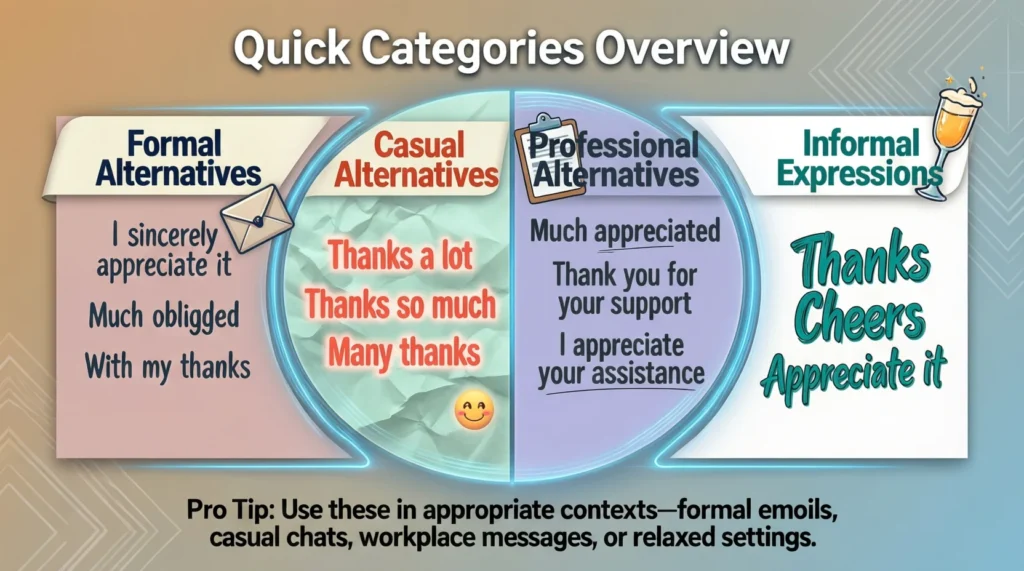
Formal alternatives to “thank you”
- I sincerely appreciate it
- Much obliged
- With my thanks
Pro Tip: Use these in formal emails, academic writing, or official communication.
Casual alternatives
- Thanks a lot
- Thanks so much
- Many thanks
Pro Tip: Perfect for everyday conversations and friendly messages.
Professional alternatives
- Much appreciated
- Thank you for your support
- I appreciate your assistance
Pro Tip: Ideal for workplace emails and meetings.
Informal expressions
- Thanks
- Cheers
- Appreciate it
Pro Tip: Use only in relaxed, familiar settings.
“Professional English values variety more than repetition.”
Common Mistakes When Using “Thank You”
- Overusing “thank you” in the same message
Example: Thank you for your time. Thank you for your help. - Using informal thanks in professional emails
Example: Cheers for the update. - Sounding robotic or forced
Example: Thank you very much indeed for everything. - Forgetting context and tone
Example: Thanks! in a formal complaint email - Missing opportunities to personalize gratitude
Example: Thank you, without mentioning what you’re thankful for.
What Does “Thank You” Mean?
“Thank you” is an expression of gratitude used to acknowledge help, kindness, or a benefit received.
Grammatically, it functions as a fixed expression rather than a full sentence.
Example sentence: Thank you for your assistance.
When to Use “Thank You”
- Receiving help or support
- Accepting gifts or compliments
- Ending emails politely
- Showing appreciation
Spoken vs Written: Common in both
Formal vs Informal: Neutral, context-dependent
Is It Professional or Polite to Say “Thank You”?
Polite: Yes
Professional: Yes
Business example: Thank you for your prompt response.
Pros and Cons of Using “Thank You”
Pros
- Universally polite
- Easy to understand
- Appropriate in most contexts
- Encourages positive communication
Cons
- Overused
- Can sound generic
- Limited emotional range
- Less impactful in formal writing if repeated
“Strong gratitude builds stronger professional relationships.”
Other Ways to Say “Thank You” (With Examples)
These alternatives help you sound more fluent, confident, and natural in different situations.
Use them according to tone, context, and audience to express appreciation clearly.
1. Phrase: Much appreciated
Meaning: I value this greatly.
Explanation: Professional and concise.
Example Sentence: Your quick response is much appreciated.
Best Use: Workplace
Worst Use: Emotional moments
Tone: Professional polite
Context Variability: professional written
2. Phrase: Thanks a lot
Meaning: Strong appreciation.
Explanation: Casual but warm.
Example Sentence: Thanks a lot for helping me out.
Best Use: Friendly talk
Worst Use: Formal letters
Tone: Casual friendly
Context Variability: casual spoken
3. Phrase: I really appreciate it
Meaning: Genuine gratitude.
Explanation: Emphasizes sincerity.
Example Sentence: I really appreciate your support.
Best Use: Personal and work
Worst Use: Very formal writing
Tone: Warm sincere
Context Variability: spoken professional
4. Phrase: Many thanks
Meaning: Polite appreciation.
Explanation: Slightly formal.
Example Sentence: Many thanks for the update.
Best Use: Emails
Worst Use: Casual chat
Tone: Polite neutral
Context Variability: professional written
5. Phrase: I’m grateful
Meaning: Deep appreciation.
Explanation: Emotional and sincere.
Example Sentence: I’m grateful for your guidance.
Best Use: Personal messages
Worst Use: Quick replies
Tone: Sincere warm
Context Variability: spoken
6. Phrase: Much obliged
Meaning: Formal gratitude.
Explanation: Old-fashioned formal tone.
Example Sentence: Much obliged for your assistance.
Best Use: Formal writing
Worst Use: Casual talk
Tone: Formal respectful
Context Variability: written
7. Phrase: Thank you kindly
Meaning: Polite thanks.
Explanation: Slightly formal.
Example Sentence: Thank you kindly for your help.
Best Use: Polite conversation
Worst Use: Casual slang
Tone: Polite gentle
Context Variability: spoken
8. Phrase: I appreciate your help
Meaning: Clear gratitude.
Explanation: Professional and direct.
Example Sentence: I appreciate your help with this task.
Best Use: Work context
Worst Use: Informal chat
Tone: Professional
Context Variability: professional
9. Phrase: Thanks so much
Meaning: Strong casual thanks.
Explanation: Friendly emphasis.
Example Sentence: Thanks so much for coming.
Best Use: Friendly messages
Worst Use: Formal emails
Tone: Casual warm
Context Variability: spoken
10. Phrase: With thanks
Meaning: Formal appreciation.
Explanation: Often used in writing.
Example Sentence: Please find the document attached, with thanks.
Best Use: Formal emails
Worst Use: Spoken English
Tone: Formal
Context Variability: written
11. Phrase: I sincerely appreciate it
Meaning: Deep formal gratitude.
Explanation: Professional sincerity.
Example Sentence: I sincerely appreciate your cooperation.
Best Use: Business writing
Worst Use: Casual talk
Tone: Formal sincere
Context Variability: professional
12. Phrase: Appreciate it
Meaning: Casual thanks.
Explanation: Shortened informal form.
Example Sentence: Appreciate it, thanks.
Best Use: Casual talk
Worst Use: Formal writing
Tone: Informal
Context Variability: spoken
13. Phrase: Thanks for your time
Meaning: Polite appreciation.
Explanation: Common in meetings.
Example Sentence: Thanks for your time today.
Best Use: Professional meetings
Worst Use: Casual chat
Tone: Professional polite
Context Variability: professional
14. Phrase: I’m thankful
Meaning: Emotional gratitude.
Explanation: Personal tone.
Example Sentence: I’m thankful for your honesty.
Best Use: Personal messages
Worst Use: Business emails
Tone: Warm sincere
Context Variability: spoken
15. Phrase: Many thanks to you
Meaning: Personal appreciation.
Explanation: Slightly formal.
Example Sentence: Many thanks to you for the help.
Best Use: Emails
Worst Use: Casual talk
Tone: Polite
Context Variability: written
16. Phrase: Thanks a million
Meaning: Strong informal gratitude.
Explanation: Expressive emphasis.
Example Sentence: Thanks a million for this.
Best Use: Casual situations
Worst Use: Formal writing
Tone: Informal enthusiastic
Context Variability: spoken
17. Phrase: I appreciate it very much
Meaning: Strong appreciation.
Explanation: Polite emphasis.
Example Sentence: I appreciate it very much.
Best Use: Polite speech
Worst Use: Casual slang
Tone: Polite sincere
Context Variability: spoken
18. Phrase: I owe you one
Meaning: Gratitude with obligation.
Explanation: Informal expression.
Example Sentence: I owe you one for this.
Best Use: Friends
Worst Use: Workplace
Tone: Informal friendly
Context Variability: spoken
19. Phrase: Thank you for your support
Meaning: Professional gratitude.
Explanation: Acknowledges help.
Example Sentence: Thank you for your support throughout the project.
Best Use: Workplace
Worst Use: Casual chat
Tone: Professional
Context Variability: professional
20. Phrase: With appreciation
Meaning: Formal thanks.
Explanation: Written usage.
Example Sentence: With appreciation, the management team.
Best Use: Formal letters
Worst Use: Spoken English
Tone: Formal
Context Variability: written
21. Phrase: I can’t thank you enough
Meaning: Very strong gratitude.
Explanation: Emotional emphasis.
Example Sentence: I can’t thank you enough for this.
Best Use: Personal support
Worst Use: Formal emails
Tone: Emotional warm
Context Variability: spoken
22. Phrase: Thanks for the help
Meaning: Casual gratitude.
Explanation: Direct and friendly.
Example Sentence: Thanks for the help earlier.
Best Use: Everyday talk
Worst Use: Formal writing
Tone: Casual
Context Variability: spoken
23. Phrase: I truly appreciate it
Meaning: Genuine thanks.
Explanation: Sincere emphasis.
Example Sentence: I truly appreciate your effort.
Best Use: Professional or personal
Worst Use: Quick replies
Tone: Sincere
Context Variability: professional
24. Phrase: Thank you very much
Meaning: Polite emphasis.
Explanation: Common neutral phrase.
Example Sentence: Thank you very much for attending.
Best Use: Polite contexts
Worst Use: Overuse
Tone: Neutral polite
Context Variability: spoken written
25. Phrase: Forever grateful
Meaning: Lasting gratitude.
Explanation: Emotional and personal.
Example Sentence: Forever grateful for your kindness.
Best Use: Personal messages
Worst Use: Business emails
Tone: Emotional
Context Variability: written
26. Phrase: Cheers
Meaning: Casual thanks.
Explanation: Informal British usage.
Example Sentence: Cheers for the update.
Best Use: Casual chat
Worst Use: Formal writing
Tone: Informal
Context Variability: spoken
27. Phrase: Thanks kindly
Meaning: Polite gratitude.
Explanation: Slightly formal.
Example Sentence: Thanks kindly for your help.
Best Use: Polite talk
Worst Use: Casual slang
Tone: Polite
Context Variability: spoken
28. Phrase: I appreciate your time
Meaning: Professional thanks.
Explanation: Respectful tone.
Example Sentence: I appreciate your time and effort.
Best Use: Meetings
Worst Use: Casual chat
Tone: Professional
Context Variability: professional
29. Phrase: Grateful for this
Meaning: Short appreciation.
Explanation: Informal written tone.
Example Sentence: Grateful for this opportunity.
Best Use: Social posts
Worst Use: Formal letters
Tone: Warm
Context Variability: written
30. Phrase: Thank you so much
Meaning: Strong friendly gratitude.
Explanation: Expressive emphasis.
Example Sentence: Thank you so much for everything.
Best Use: Friendly messages
Worst Use: Very formal writing
Tone: Warm polite
Context Variability: spoken
Comparison Table: Top Alternatives
| Phrase | Tone | Best Use |
|---|---|---|
| Much appreciated | Professional | Work emails |
| Many thanks | Polite | Emails |
| I truly appreciate it | Sincere | Professional |
| Thanks a lot | Casual | Friendly talk |
| I sincerely appreciate it | Formal | Business |
| Cheers | Informal | Casual |
| I appreciate your help | Professional | Workplace |
| Thank you kindly | Polite | Spoken |
| I can’t thank you enough | Emotional | Personal |
| With appreciation | Formal | Letters |
“Varied gratitude makes your English sound thoughtful and confident.”
Mini Quiz
- Which phrase is best for a formal email?
A Cheers
B Much obliged
C Thanks a million - Which phrase is most casual?
A With appreciation
B Thanks so much
C I sincerely appreciate it - Which shows deep emotional gratitude?
A Many thanks
B I can’t thank you enough
C Thanks
Answers: 1 B, 2 B, 3 B
FAQs
What are the best professional alternatives to thank you?
Use phrases like much appreciated or I appreciate your assistance.
Can I say cheers instead of thank you?
Yes, but only in informal or casual settings.
How can I sound more fluent when saying thank you?
Use varied alternatives and match the tone to the situation.
Is thank you too basic for professional English?
No, but alternatives add clarity and professionalism.
Why should English learners learn other ways to say thank you?
It improves fluency, tone awareness, and communication confidence.
Conclusion
Learning other ways to say thank you helps you communicate appreciation more naturally and professionally.
Practice different expressions daily, stay aware of tone, and choose the right phrase for every context to build confident English communication.
If this helped you, save it and practice one new phrase today.
Read More Related Articles:
- Other Ways to Say Thank You for Letting Me Know In 2026
- Other Ways to Say If I Can Be of Any Help (2026)
- Other Ways to Say Polite Ways to Ask Are You Okay in 2026

Tom Sanders is a professional writer at Wordsmirror.com, with a strong focus on creating informative, engaging, and easy-to-read content. He brings clarity and depth to a wide range of topics, helping readers understand ideas quickly and confidently. Tom is committed to delivering high-quality writing that is both accurate and reader-focused.