Quick Answer
If you want alternatives to ways to say sorry for bothering you, try these top options: Sorry to interrupt, Apologies for the inconvenience, Excuse the interruption, Hope I am not disturbing you, Pardon me for taking your time.
The phrase sorry for bothering you is a polite way to apologize for interrupting someone’s time, attention, or workflow. English speakers often use it before asking a question, making a request, or following up on something.
While common and friendly, repeating the same phrase can make your English sound limited or overly informal. That is why learning alternatives to ways to say sorry for bothering you helps you sound more fluent, confident, and precise.
Just like learning how to express excitement in English, mastering polite variations improves both spoken and written communication, especially in professional and academic settings.
“Polite English is not about longer sentences. It is about better choices.”
Quick Categories
Formal alternatives to “sorry for bothering you”
• Apologies for the inconvenience
• Pardon the interruption
• Please excuse the disturbance
Pro Tip: Use formal phrases in emails, presentations, and official requests.
Casual alternatives
• Sorry to bug you
• Hope I am not interrupting
• Just a quick question
Pro Tip: Casual phrases work best in friendly conversations, not business writing.
Professional alternatives
• Sorry to interrupt your schedule
• Thank you for your time
• I appreciate your attention
Pro Tip: In workplaces, gratitude often sounds more confident than apology.
Informal expressions
• Sorry to bother
• Quick thing
• Can I ask you something
Pro Tip: Informal expressions are common in spoken English but weak in formal writing.
Common Mistakes When Using “Sorry for Bothering You”
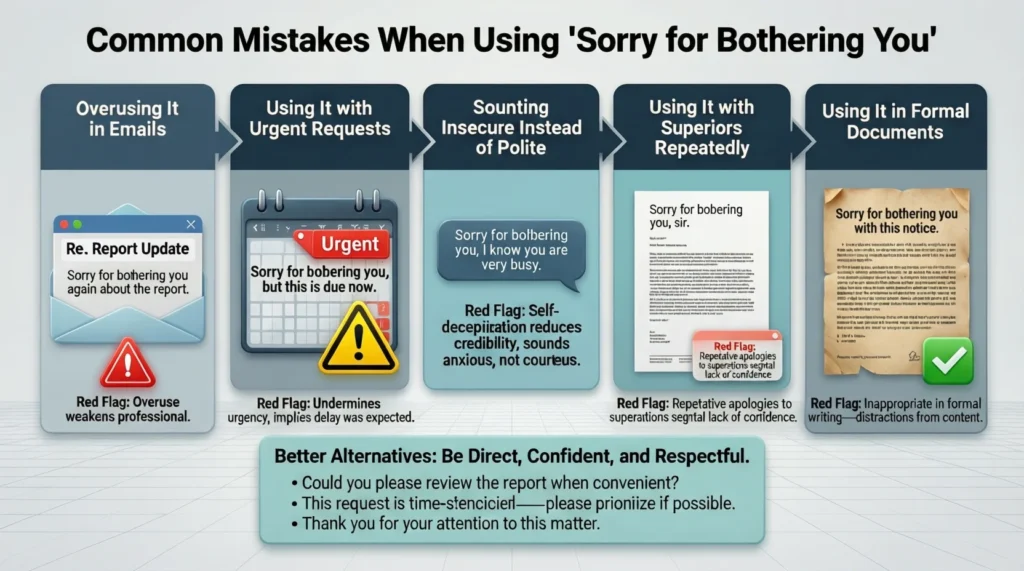
- Overusing it in emails
Example: Sorry for bothering you again about the report. - Using it with urgent requests
Example: Sorry for bothering you, but this is due now. - Sounding insecure instead of polite
Example: Sorry for bothering you, I know you are very busy. - Using it with superiors repeatedly
Example: Sorry for bothering you, sir. - Using it in formal documents
Example: Sorry for bothering you with this notice.
“Professional English favors clarity and confidence over apology.”
What Does “Sorry for Bothering You” Mean?
It means apologizing for interrupting, disturbing, or taking someone’s time.
Grammatically, it uses sorry for + gerund to explain the reason for the apology.
Example:
Sorry for bothering you so late in the evening.
When to Use “Sorry for Bothering You”
• Asking a small favor
• Interrupting someone briefly
• Starting a casual email
• Spoken English more than written
• Informal and semi polite contexts
Is It Professional or Polite to Say “Sorry for Bothering You”?
It is polite but usually not professional.
Business Example:
Sorry for bothering you about the meeting agenda.
Polite? ✔️ Yes
Professional? ❌ No in most cases
Pros and Cons of Using “Sorry for Bothering You”
Pros
• Simple and natural
• Friendly tone
• Common usage
• Easy to understand
Cons
• Too informal for work
• Overused
• Limited emotional range
• Not suitable for formal writing
Other Ways to Say “Sorry for Bothering You” (With Examples)
These other ways to say sorry for bothering you will help you sound fluent, confident, and natural.
Choose them based on tone, context, and audience to express excitement in English, respect, or professionalism.
1. Phrase: Sorry to interrupt
Meaning: Apologizing for breaking someone’s focus.
Explanation: Neutral and widely accepted.
Example Sentence: Sorry to interrupt, may I ask a quick question?
Best Use: Meetings
Worst Use: Formal letters
Tone: Polite, neutral
Context Variability: casual, professional, spoken
2. Phrase: Apologies for the inconvenience
Meaning: A formal apology for disruption.
Explanation: Common in professional writing.
Example Sentence: Apologies for the inconvenience caused.
Best Use: Emails
Worst Use: Casual chat
Tone: Formal, respectful
Context Variability: professional
3. Phrase: Excuse the interruption
Meaning: Polite acknowledgment of disruption.
Explanation: Slightly formal alternative.
Example Sentence: Excuse the interruption, I need clarification.
Best Use: Office talk
Worst Use: Texting
Tone: Polite, calm
Context Variability: professional, spoken
4. Phrase: Hope I am not disturbing you
Meaning: Gentle and considerate apology.
Explanation: Softens the request.
Example Sentence: Hope I am not disturbing you at work.
Best Use: Polite calls
Worst Use: Urgent matters
Tone: Gentle, respectful
Context Variability: casual, spoken
5. Phrase: Pardon me for taking your time
Meaning: Respecting someone’s schedule.
Explanation: Shows awareness of time value.
Example Sentence: Pardon me for taking your time today.
Best Use: Formal talk
Worst Use: Casual chat
Tone: Formal, courteous
Context Variability: professional
6. Phrase: Sorry to trouble you
Meaning: Apology for creating effort.
Explanation: Common in polite English.
Example Sentence: Sorry to trouble you with this request.
Best Use: Requests
Worst Use: Informal jokes
Tone: Polite, modest
Context Variability: casual, professional
7. Phrase: I appreciate your time
Meaning: Gratitude instead of apology.
Explanation: Sounds confident and professional.
Example Sentence: I appreciate your time reviewing this.
Best Use: Business
Worst Use: Interruptions
Tone: Professional, respectful
Context Variability: professional
8. Phrase: Thank you for your patience
Meaning: Acknowledging inconvenience positively.
Explanation: Avoids apologizing directly.
Example Sentence: Thank you for your patience during the delay.
Best Use: Customer service
Worst Use: Casual talk
Tone: Polite, professional
Context Variability: professional
9. Phrase: Sorry to take up your time
Meaning: Apology for using time.
Explanation: Common spoken phrase.
Example Sentence: Sorry to take up your time, but I need help.
Best Use: Spoken requests
Worst Use: Formal writing
Tone: Polite, casual
Context Variability: casual, spoken
10. Phrase: May I have a moment?
Meaning: Requesting brief attention.
Explanation: Polite and neutral.
Example Sentence: May I have a moment to explain?
Best Use: Meetings
Worst Use: Emails
Tone: Polite, confident
Context Variability: professional, spoken
11. Phrase: Pardon the interruption
Meaning: A formal apology for interrupting someone.
Explanation: Polite and slightly more formal than “sorry to interrupt.”
Example Sentence: Pardon the interruption, may I add one point?
Best Use: Meetings
Worst Use: Casual chat
Tone: Formal, respectful
Context Variability: professional, spoken
12. Phrase: Please excuse the interruption
Meaning: A courteous request for forgiveness while interrupting.
Explanation: Softens the interruption politely.
Example Sentence: Please excuse the interruption, I need clarification.
Best Use: Presentations
Worst Use: Text messages
Tone: Polite, formal
Context Variability: professional, spoken
13. Phrase: Sorry to take a moment of your time
Meaning: Apologizing for briefly using someone’s time.
Explanation: Sounds considerate and polite.
Example Sentence: Sorry to take a moment of your time, I have a question.
Best Use: Polite requests
Worst Use: Urgent matters
Tone: Courteous, gentle
Context Variability: casual, professional
14. Phrase: I hope this is a good time
Meaning: Checking availability politely.
Explanation: Shows respect for the listener’s schedule.
Example Sentence: I hope this is a good time to discuss the update.
Best Use: Calls
Worst Use: Formal notices
Tone: Polite, thoughtful
Context Variability: professional, spoken
15. Phrase: Sorry to bother
Meaning: Short apology for interrupting.
Explanation: A very brief, informal version.
Example Sentence: Sorry to bother, can you help me?
Best Use: Casual talk
Worst Use: Business emails
Tone: Casual, polite
Context Variability: informal, spoken
“Shorter phrases often sound more natural in spoken English.”
16. Phrase: Can I take a minute of your time?
Meaning: Politely asking for attention.
Explanation: Sounds confident and respectful.
Example Sentence: Can I take a minute of your time regarding the report?
Best Use: Workplace
Worst Use: Interrupting urgently
Tone: Polite, confident
Context Variability: professional, spoken
17. Phrase: I appreciate you taking the time
Meaning: Thanking instead of apologizing.
Explanation: Strong professional alternative.
Example Sentence: I appreciate you taking the time to meet today.
Best Use: Business
Worst Use: Interruptions
Tone: Professional, appreciative
Context Variability: professional
18. Phrase: Sorry to disturb you
Meaning: Apologizing for causing a disturbance.
Explanation: Slightly more formal than “sorry to bother.”
Example Sentence: Sorry to disturb you, I need assistance.
Best Use: Polite requests
Worst Use: Casual jokes
Tone: Polite, neutral
Context Variability: casual, professional
19. Phrase: I hope I’m not interrupting anything important
Meaning: Showing concern about timing.
Explanation: Sounds thoughtful and considerate.
Example Sentence: I hope I’m not interrupting anything important.
Best Use: Calls
Worst Use: Formal writing
Tone: Gentle, polite
Context Variability: spoken, casual
20. Phrase: Thank you for your time and attention
Meaning: Respectful acknowledgment of effort.
Explanation: Common in formal communication.
Example Sentence: Thank you for your time and attention to this matter.
Best Use: Emails
Worst Use: Casual chat
Tone: Formal, respectful
Context Variability: professional
“Professional English often replaces apology with appreciation.”
21. Phrase: Sorry for the interruption
Meaning: Direct apology for interrupting.
Explanation: Neutral and widely accepted.
Example Sentence: Sorry for the interruption, may I continue?
Best Use: Meetings
Worst Use: Formal documents
Tone: Neutral, polite
Context Variability: spoken, professional
22. Phrase: May I briefly interrupt?
Meaning: Requesting permission to interrupt.
Explanation: Sounds respectful and controlled.
Example Sentence: May I briefly interrupt with a question?
Best Use: Discussions
Worst Use: Casual texting
Tone: Polite, formal
Context Variability: professional, spoken
23. Phrase: I know you’re busy, but…
Meaning: Acknowledging someone’s schedule.
Explanation: Shows awareness but can sound apologetic if overused.
Example Sentence: I know you’re busy, but I need clarification.
Best Use: Spoken requests
Worst Use: Formal writing
Tone: Considerate, informal
Context Variability: casual, spoken
24. Phrase: Forgive the interruption
Meaning: Asking forgiveness politely.
Explanation: Slightly formal and respectful.
Example Sentence: Forgive the interruption, I need to add something.
Best Use: Formal speech
Worst Use: Casual chat
Tone: Formal, courteous
Context Variability: professional
25. Phrase: If you have a moment
Meaning: Soft request for attention.
Explanation: Sounds gentle and non intrusive.
Example Sentence: If you have a moment, could we talk?
Best Use: Requests
Worst Use: Urgent issues
Tone: Polite, gentle
Context Variability: casual, professional
“The best phrase depends on tone, timing, and audience.”
26. Phrase: Just a quick question
Meaning: Minimizing the interruption.
Explanation: Very common in spoken English.
Example Sentence: Just a quick question before you go.
Best Use: Casual talk
Worst Use: Formal meetings
Tone: Casual, friendly
Context Variability: informal, spoken
27. Phrase: I hope this doesn’t inconvenience you
Meaning: Polite concern about impact.
Explanation: Sounds considerate and respectful.
Example Sentence: I hope this doesn’t inconvenience you too much.
Best Use: Emails
Worst Use: Casual chat
Tone: Polite, formal
Context Variability: professional
28. Phrase: Thank you for your understanding
Meaning: Polite acknowledgment of patience.
Explanation: Often used after inconvenience.
Example Sentence: Thank you for your understanding.
Best Use: Customer service
Worst Use: Interruptions
Tone: Professional, courteous
Context Variability: professional
29. Phrase: I’ll be brief
Meaning: Reassuring minimal interruption.
Explanation: Shows respect for time.
Example Sentence: I’ll be brief, I just need confirmation.
Best Use: Meetings
Worst Use: Casual talk
Tone: Confident, polite
Context Variability: professional, spoken
30. Phrase: Appreciate you hearing me out
Meaning: Thanking someone for listening.
Explanation: Friendly and conversational.
Example Sentence: I appreciate you hearing me out.
Best Use: Discussions
Worst Use: Formal documents
Tone: Warm, appreciative
Context Variability: casual, spoken
“Replacing apologies with appreciation instantly upgrades your professional English.”
Comparison Table: Top Alternatives
| Phrase | Tone | Best Use |
|---|---|---|
| Sorry to interrupt | Neutral | Meetings |
| Apologies for the inconvenience | Formal | Emails |
| Excuse the interruption | Polite | Office |
| I appreciate your time | Professional | Business |
| May I have a moment | Confident | Speaking |
| Sorry to trouble you | Polite | Requests |
| Thank you for your patience | Professional | Service |
| Pardon me | Formal | Presentations |
| Hope I am not disturbing you | Gentle | Calls |
| Sorry to take up your time | Casual | Spoken |
Formal vs Informal Usage Table
| Type | Recommended Phrase |
|---|---|
| Formal | Apologies for the inconvenience |
| Professional | I appreciate your time |
| Casual | Sorry to bother |
| Spoken | Hope I am not interrupting |
Mini Quiz: Self Check
- Which phrase is best for a business email?
A. Sorry to bug you
B. Apologies for the inconvenience
C. Quick thing - Which sounds most confident?
A. Sorry for bothering you again
B. I appreciate your time
C. Sorry to disturb - Which is too informal for work?
A. Sorry to trouble you
B. Sorry to bug you
C. Excuse the interruption
FAQs
1. Are there professional alternatives to ways to say sorry for bothering you?
Yes. Phrases like I appreciate your time and Apologies for the inconvenience are better for work.
2. Is “sorry for bothering you” polite?
Yes, but it is more informal than professional.
3. Can I use it in emails?
Only in casual or friendly emails, not formal ones.
4. What is the most formal alternative?
Apologies for the inconvenience is one of the most formal options.
5. How can I sound confident instead of apologetic?
Replace apologies with gratitude and clarity.
Conclusion
Learning ways to say sorry for bothering you helps you communicate politely without sounding unsure or repetitive. The right phrase improves tone, professionalism, and fluency.
Practice these alternatives daily, notice tone differences, and choose based on context. Polite English is powerful when used with confidence and awareness.
CTA: Which phrase will you start using today? Try it in your next email or conversation.
Read More Related Articles:
- Other Simple Ways to Say Please Be Reminded (2026)
- Other Ways to Say Looking Forward to It (2026)
- Other Ways to Say Thank You for Clarifying (2026)

Tom Sanders is a professional writer at Wordsmirror.com, with a strong focus on creating informative, engaging, and easy-to-read content. He brings clarity and depth to a wide range of topics, helping readers understand ideas quickly and confidently. Tom is committed to delivering high-quality writing that is both accurate and reader-focused.