Quick Answer
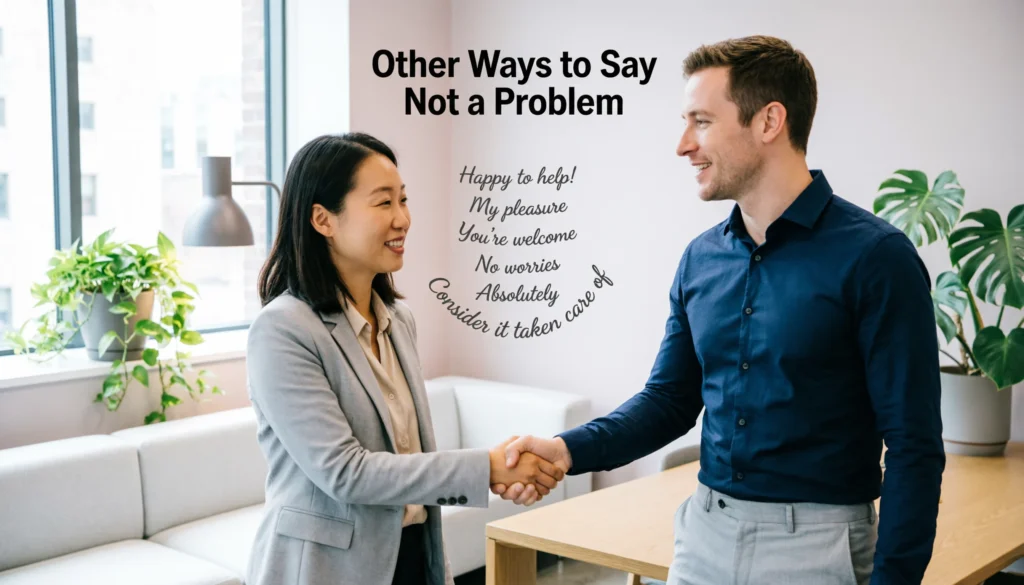
If you’re looking for other ways to say not a problem, try: No worries, My pleasure, Happy to help, Of course, Anytime.
These alternatives work in casual conversations, professional emails, and customer service situations.
The phrase not a problem is commonly used to respond to thanks or reassure someone that something was easy to do.
People use it in daily conversations, workplace emails, and service interactions to show willingness or kindness. However, in some professional settings, it may sound slightly informal.
Learning alternatives to not a problem helps you express excitement in English, sound more polished, and use appropriate tone in professional communication.
“The way you respond to ‘thank you’ says a lot about your professionalism.”
Quick Categories Overview
Formal alternatives to “not a problem”
- My pleasure
- It was no trouble at all
- I’m glad to assist
Pro Tip: Choose these in business emails, interviews, or formal customer service responses.
Casual alternatives
- No worries
- Sure thing
- Anytime
Pro Tip: Perfect for friends, coworkers, or relaxed conversations.
Professional alternatives
- Happy to help
- Of course
- It was my pleasure
Pro Tip: Ideal for workplace communication and client interactions.
Informal expressions
- No big deal
- Don’t mention it
- All good
Pro Tip: Best for friendly, spoken English situations.
“Small language choices create big professional impressions.”
Common Mistakes When Using “Not a Problem”
- Using it in very formal writing
Example: Not a problem, Sir. → Slightly too casual - Overusing it in every email
Example: Not a problem repeated frequently → Repetitive tone - Using it when the task was actually difficult
Example: Not a problem (after major work) → Can minimize effort - Using it sarcastically
Example: Not a problem… → Negative tone - Saying it in sensitive situations
Example: After someone apologizes deeply → May sound dismissive
What Does “Not a Problem” Mean?
It means the task or favor was easy or acceptable to do.
Grammar: Fixed informal response phrase, often used after someone says “thank you” or apologizes.
Example:
Thanks for helping me.
Not a problem!
When to Use “Not a Problem”
- Responding to thanks
- Reassuring someone
- Casual workplace settings
- Friendly conversations
Spoken vs Written: Very common in spoken English
Formal vs Informal: Mostly informal or semi-professional
Is It Professional or Polite to Say “Not a Problem”?
Polite? ✔️ Yes
Professional? ❌ Not always (depends on tone and industry)
Some experts believe it can imply there could have been a problem.
Business-style example:
Thank you for sending the report.
Not a problem. I’m happy to assist.
In highly formal environments, “My pleasure” may sound more refined.
Pros and Cons of Using “Not a Problem”
Pros
- Simple and natural
- Friendly tone
- Very common usage
- Easy to understand
Cons
- Too informal for some workplaces
- Overused
- Limited emotional range
- Not ideal for formal writing
“Professional reaction phrases make your English sound confident and intentional.”
Other Ways to Say “Not a Problem” (30 Alternatives)
These alternatives help you sound more fluent, confident, and natural in different situations.
Use them according to tone, context, and audience to maintain professionalism or friendliness.
1. Phrase: No worries
Meaning: It’s okay, don’t stress
Explanation: Casual reassurance
Example Sentence: No worries, I’ve already handled it.
Best Use: Casual chats
Worst Use: Formal letters
Tone: Relaxed, friendly
Context Variability: casual, spoken
2. Phrase: My pleasure
Meaning: I was happy to help
Explanation: Polite and refined
Example Sentence: My pleasure. Let me know if you need anything else.
Best Use: Professional emails
Worst Use: Very casual texting
Tone: Polished, courteous
Context Variability: professional, customer service
3. Phrase: Happy to help
Meaning: I’m glad I could assist
Explanation: Professional yet warm
Example Sentence: Happy to help with the presentation updates.
Best Use: Workplace
Worst Use: Sarcastic tone
Tone: Friendly, professional
Context Variability: professional, spoken
4. Phrase: Anytime
Meaning: I’m always willing
Explanation: Casual willingness
Example Sentence: Anytime! Just let me know.
Best Use: Friends
Worst Use: Formal reports
Tone: Casual, open
Context Variability: spoken
5. Phrase: Of course
Meaning: Naturally, yes
Explanation: Shows readiness
Example Sentence: Of course, I’ll send the file again.
Best Use: Professional
Worst Use: Defensive tone
Tone: Confident, neutral
Context Variability: professional, spoken
6. Phrase: Don’t mention it
Meaning: No need to thank me
Explanation: Polite dismissal of thanks
Example Sentence: Don’t mention it. It was simple.
Best Use: Semi-formal
Worst Use: Formal speeches
Tone: Polite, relaxed
Context Variability: spoken, casual
7. Phrase: It was no trouble at all
Meaning: It wasn’t difficult
Explanation: Formal reassurance
Example Sentence: It was no trouble at all assisting you.
Best Use: Professional emails
Worst Use: Text messages
Tone: Professional, polite
Context Variability: professional
8. Phrase: Sure thing
Meaning: Yes, gladly
Explanation: Casual agreement
Example Sentence: Sure thing, I’ll take care of it.
Best Use: Casual workplace
Worst Use: Formal writing
Tone: Friendly, informal
Context Variability: spoken
9. Phrase: Glad to help
Meaning: Happy assistance
Explanation: Warm but professional
Example Sentence: Glad to help with your request.
Best Use: Professional
Worst Use: Sarcasm
Tone: Friendly, professional
Context Variability: email, spoken
10. Phrase: All good
Meaning: Everything is fine
Explanation: Informal reassurance
Example Sentence: All good, no need to apologize.
Best Use: Friends
Worst Use: Business emails
Tone: Casual, relaxed
Context Variability: spoken
“Tone awareness transforms simple phrases into powerful communication tools.”
Comparison Table: Top Alternatives
| Phrase | Tone | Best Use |
|---|---|---|
| My pleasure | Polished | Business emails |
| Happy to help | Professional | Workplace |
| Of course | Neutral | All settings |
| No worries | Casual | Friends |
| Glad to help | Warm | Semi-formal |
| It was no trouble | Formal | Client emails |
| Anytime | Casual | Spoken |
| Absolutely | Confident | Professional |
| Certainly | Formal | Business |
| Don’t mention it | Polite | Semi-formal |
When to Use Alternatives vs “Not a Problem”
| Situation | Best Alternative |
|---|---|
| Formal email | My pleasure |
| Customer service | Happy to assist |
| Casual friend | No worries |
| Team meeting | Glad to help |
| Apology response | Not at all |
Mini Quiz
- Which phrase is most professional?
A No worries
B My pleasure
C No big deal - Which phrase is informal?
A Certainly
B No hassle
C With pleasure - What is safest for client communication?
A Anytime
B Happy to assist
C All good
Answers: 1 B, 2 B, 3 B
FAQs
Is “not a problem” rude?
No, but in very formal contexts it may sound slightly informal.
What is the most professional alternative?
“My pleasure” or “Happy to assist.”
Is “no worries” appropriate at work?
Only in relaxed workplaces.
What’s better in customer service?
“It was my pleasure” sounds more refined.
Why learn other ways to say not a problem?
It improves tone control, professionalism, and fluency.
Conclusion
Learning other ways to say not a problem allows you to adapt your tone for casual, professional, or formal situations.
By practicing these professional reaction phrases and informal expressions in English, you’ll sound more confident, polished, and fluent every day.
If this article helped you, try using three new phrases in your next conversation.
Read More Related Articles:
- Other Ways to Say “Have a Nice Day”: Upgrade Your Goodbye In 2026
- Other Ways to Say I Need Your Help with 30+ Examples For 2026
- Other Ways to Ask What Does That Mean In 2026

Tom Sanders is a professional writer at Wordsmirror.com, with a strong focus on creating informative, engaging, and easy-to-read content. He brings clarity and depth to a wide range of topics, helping readers understand ideas quickly and confidently. Tom is committed to delivering high-quality writing that is both accurate and reader-focused.