
Quick Answer 🔥
Top Alternatives: “It’s okay,” “No problem,” “Don’t worry about it,” “All good,” “That’s fine”
“No worries” is a friendly, casual way to show someone that a mistake or request isn’t a problem. You can respond confidently with these alternatives depending on tone and context.
The phrase “no worries” is commonly used in casual conversations to reassure someone or accept thanks. It’s popular in informal English but may not always suit professional or formal contexts.
Learning alternatives to “no worries” helps you express excitement in English, sound natural, and adapt your tone for friends, colleagues, or formal interactions.
By exploring multiple responses, you can communicate clearly, sound confident, and maintain politeness in every setting.
Quick Categories of Alternatives
Formal Alternatives to “No Worries”
- “It’s quite all right.”
- “That’s perfectly fine.”
- “Don’t mention it.”
- “You’re welcome.”
Pro Tip: Use formal alternatives in business emails, meetings, or with clients to maintain professionalism.
Casual Alternatives
- “No problem.”
- “All good.”
- “It’s okay.”
- “No big deal.”
Pro Tip: Casual phrases fit friends, family, and informal conversations while keeping your tone friendly.
Professional Alternatives
- “Happy to help.”
- “Glad I could assist.”
- “It was no trouble at all.”
- “My pleasure.”
Pro Tip: Professional responses are ideal for workplace emails, presentations, or client interactions.
Informal Expressions
- “Don’t worry about it.”
- “No sweat.”
- “No hassle.”
- “It’s nothing.”
Pro Tip: Informal phrases are great for texting, chats, or lighthearted spoken conversations.
Common Mistakes
- Using slang in formal settings
Example: “No sweat!” — too casual for work - Overusing the phrase
Example: “No worries, no worries” — repetitive - Responding too casually in professional emails
Example: “All good!” — may feel unprofessional - Misunderstanding context
Example: “It’s nothing” — can sound dismissive if overused - Mixing tones
Example: “It’s nothing, don’t mention it!” — overly informal in formal context
What Does “No Worries” Mean?
Definition: A casual way to indicate that something is not a problem or that you accept thanks.
Grammar: Usually a short, informal interjection or phrase.
Example: “Thanks for helping me!” – “No worries.”
When to Use “No Worries”
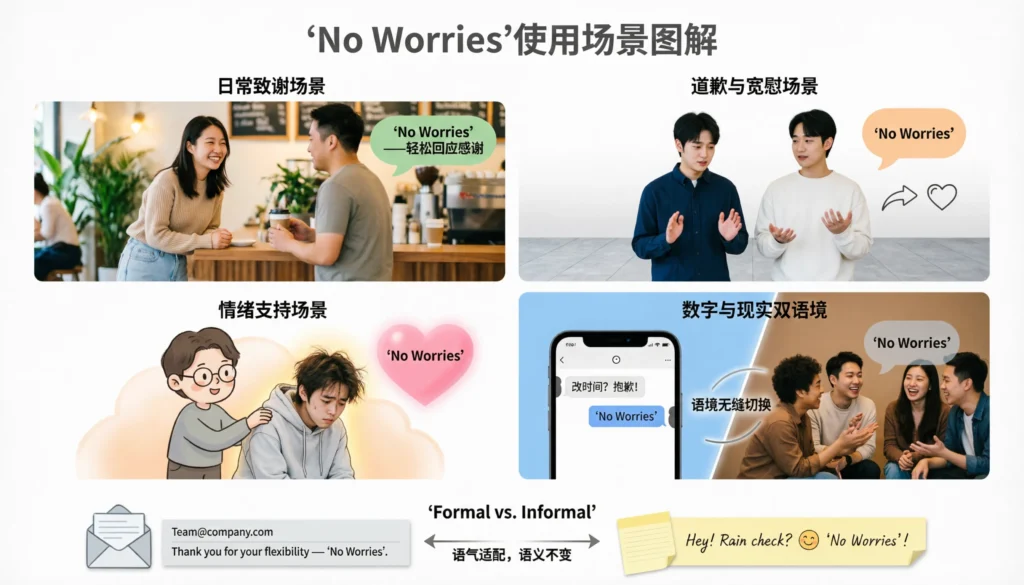
- Accepting thanks
- Responding to apologies
- Reassuring someone
- Spoken vs. written: Informal chats vs text messages
- Formal vs. informal: Work emails vs personal conversations
Is It Professional or Polite to Say “No Worries”?
- Polite? ✔️ Yes
- Professional? ⚠️ Usually informal
Business Example: “Thank you for completing the report.” – “Happy to help.”
Pros and Cons of Using “No Worries”
Pros:
- Friendly and approachable
- Simple and natural
- Widely recognized
- Easy to understand
Cons:
- Too informal for formal writing
- Overused in casual speech
- Limited in tone variety
- May not suit professional communication
“The right phrase makes your English sound confident and natural.”
Other Ways to Say “No Worries” (30+ Examples)
These alternatives help you sound more fluent, confident, and natural. Use them according to tone, context, and audience.
1–10
- Phrase: It’s okay
- Meaning: Casual reassurance
- Example: “Sorry I’m late.” – “It’s okay.”
- Best Use: Casual | Worst Use: Formal | Tone: Friendly, neutral
- Phrase: No problem
- Meaning: Accepting thanks
- Example: “Thanks for your help.” – “No problem.”
- Best Use: Casual | Worst Use: Formal | Tone: Relaxed, approachable
- Phrase: Don’t worry about it
- Meaning: Reassuring someone
- Example: “I spilled coffee.” – “Don’t worry about it.”
- Best Use: Casual | Worst Use: Formal | Tone: Friendly, empathetic
- Phrase: All good
- Meaning: Everything is fine
- Example: “I forgot the notes.” – “All good.”
- Best Use: Casual | Worst Use: Formal | Tone: Relaxed, upbeat
- Phrase: That’s fine
- Meaning: Accepting a mistake politely
- Example: “I missed the meeting.” – “That’s fine.”
- Best Use: Casual / formal | Worst Use: Aggressive | Tone: Neutral, polite
- Phrase: No big deal
- Meaning: Reassuring someone
- Example: “Sorry for the delay.” – “No big deal.”
- Best Use: Casual | Worst Use: Formal | Tone: Relaxed, friendly
- Phrase: Don’t mention it
- Meaning: Formal or polite acknowledgment
- Example: “Thanks for the advice.” – “Don’t mention it.”
- Best Use: Formal | Worst Use: Casual slang | Tone: Polite, classic
- Phrase: My pleasure
- Meaning: Polite and professional acceptance
- Example: “Thanks for your support.” – “My pleasure.”
- Best Use: Professional | Worst Use: Informal text | Tone: Polite, respectful
- Phrase: Happy to help
- Meaning: Professional reassurance
- Example: “Thank you for assisting.” – “Happy to help.”
- Best Use: Professional | Worst Use: Casual sarcasm | Tone: Friendly, professional
- Phrase: It was no trouble at all
- Meaning: Professional acknowledgment
- Example: “Thanks for fixing the issue.” – “It was no trouble at all.”
- Best Use: Professional | Worst Use: Casual chat | Tone: Respectful, calm
“Politeness can be simple, friendly, and clear.”
11–20
- Phrase: That’s okay
- Meaning: Neutral reassurance
- Example: “Sorry I forgot.” – “That’s okay.”
- Best Use: Casual | Worst Use: Formal | Tone: Friendly, simple
- Phrase: No hassle
- Meaning: Informal reassurance
- Example: “Thanks for helping.” – “No hassle.”
- Best Use: Casual | Worst Use: Formal | Tone: Relaxed, friendly
- Phrase: No sweat
- Meaning: Informal reassurance
- Example: “Sorry for asking.” – “No sweat.”
- Best Use: Casual | Worst Use: Professional | Tone: Friendly, informal
- Phrase: It’s nothing
- Meaning: Minimalizing the effort
- Example: “Thanks for covering my shift.” – “It’s nothing.”
- Best Use: Casual | Worst Use: Professional | Tone: Humble, friendly
- Phrase: Not at all
- Meaning: Formal acknowledgment
- Example: “Thank you for your help.” – “Not at all.”
- Best Use: Formal | Worst Use: Casual slang | Tone: Polite, classic
- Phrase: That’s alright
- Meaning: Casual reassurance
- Example: “I made a mistake.” – “That’s alright.”
- Best Use: Casual | Worst Use: Strict formal | Tone: Relaxed, neutral
- Phrase: No need to worry
- Meaning: Reassuring someone
- Example: “I’m concerned I messed up.” – “No need to worry.”
- Best Use: Casual / semi-formal | Worst Use: Aggressive | Tone: Friendly, calming
- Phrase: Sure thing
- Meaning: Casual acceptance
- Example: “Thanks for your help.” – “Sure thing.”
- Best Use: Casual | Worst Use: Formal | Tone: Friendly, casual
- Phrase: That’s cool
- Meaning: Informal reassurance
- Example: “I forgot to send the email.” – “That’s cool.”
- Best Use: Casual | Worst Use: Professional | Tone: Relaxed, friendly
- Phrase: Anytime
- Meaning: Polite reassurance
- Example: “Thanks for helping.” – “Anytime.”
- Best Use: Casual / professional | Worst Use: Overused slang | Tone: Friendly, approachable
“Choosing context-appropriate alternatives avoids misunderstandings.”
21–30
- Phrase: No need
- Meaning: Informal acknowledgment
- Example: “Sorry for bothering you.” – “No need.”
- Best Use: Casual | Worst Use: Formal | Tone: Simple, friendly
- Phrase: Not a problem
- Meaning: Casual reassurance
- Example: “Thanks for helping.” – “Not a problem.”
- Best Use: Casual | Worst Use: Formal | Tone: Neutral, friendly
- Phrase: All good, no worries
- Meaning: Friendly reassurance
- Example: “Sorry I forgot.” – “All good, no worries.”
- Best Use: Casual | Worst Use: Professional | Tone: Relaxed, upbeat
- Phrase: You’re welcome
- Meaning: Polite acknowledgment
- Example: “Thanks for your time.” – “You’re welcome.”
- Best Use: Formal | Worst Use: Casual slang | Tone: Polite, professional
- Phrase: Absolutely
- Meaning: Agreeable reassurance
- Example: “Thanks for doing that.” – “Absolutely.”
- Best Use: Casual / professional | Worst Use: Overused | Tone: Confident, friendly
- Phrase: Of course
- Meaning: Polite, formal acknowledgment
- Example: “Thank you for helping.” – “Of course.”
- Best Use: Formal / casual | Worst Use: Sarcastic | Tone: Polite, friendly
- Phrase: No bother
- Meaning: Informal acknowledgment
- Example: “Thanks for assisting.” – “No bother.”
- Best Use: Casual | Worst Use: Strict formal | Tone: Friendly, humble
- Phrase: It’s all right
- Meaning: Neutral reassurance
- Example: “Sorry for the mistake.” – “It’s all right.”
- Best Use: Casual / semi-formal | Worst Use: Aggressive | Tone: Calm, neutral
- Phrase: Everything’s fine
- Meaning: Reassurance
- Example: “Did I mess up?” – “Everything’s fine.”
- Best Use: Casual / semi-formal | Worst Use: Sarcastic | Tone: Friendly, calm
- Phrase: That’s no problem
- Meaning: Polite acknowledgment
- Example: “Thanks for your assistance.” – “That’s no problem.”
- Best Use: Casual / professional | Worst Use: Overly casual | Tone: Neutral, polite
Mini Quiz / Self-Check
- Which is professional: “No sweat” or “Happy to help”?
- ✅ “Happy to help”
- Best casual reassurance:
- A) “It’s quite all right”
- B) “All good”
- ✅ B
- Which phrase is too informal for work?
- A) “Of course”
- B) “No sweat”
- ✅ B
- Proper formal acknowledgment:
- A) “Don’t worry about it”
- B) “Not at all”
- ✅ B
Comparison Table: Top 10 Alternatives
| Phrase | Tone | Best Use |
|---|---|---|
| It’s okay | Neutral | Casual |
| No problem | Relaxed | Casual |
| Don’t worry about it | Friendly | Casual / semi-formal |
| All good | Upbeat | Casual |
| That’s fine | Polite | Casual / formal |
| No big deal | Friendly | Casual |
| Don’t mention it | Polite | Formal |
| My pleasure | Respectful | Professional |
| Happy to help | Friendly | Professional |
| It was no trouble at all | Respectful | Professional |
FAQs
1. What is a polite way to say “no worries”?
Use “Not at all” or “My pleasure” in professional contexts.
2. Can “no worries” be used in business emails?
It’s informal; prefer “Happy to help” or “You’re welcome.”
3. What’s a casual alternative for friends?
“All good” or “No problem” works perfectly.
4. How do I respond to thanks in writing?
Use “Not at all,” “My pleasure,” or “It was no trouble at all.”
5. Why learn multiple alternatives?
It improves fluency, professionalism, and ability to express excitement in English naturally.
Conclusion
Learning 30 alternatives to “no worries” ensures you respond confidently in casual, semi-formal, or professional situations. You can adapt your tone, audience, and context to communicate effectively.
Practice daily by mixing formal, casual, and professional phrases. Over time, choosing the right response will feel natural, polite, and effortless.
Read More Related Articles:
- Beyond “I’ll Get Back to You”: 30+ Polished Alternatives In 2026
- How to Say “Please Be Reminded” More Naturally In 2026
- Other Ways to Say Looking Forward to Hearing From You In 2026

Tom Sanders is a professional writer at Wordsmirror.com, with a strong focus on creating informative, engaging, and easy-to-read content. He brings clarity and depth to a wide range of topics, helping readers understand ideas quickly and confidently. Tom is committed to delivering high-quality writing that is both accurate and reader-focused.