Quick Answer:
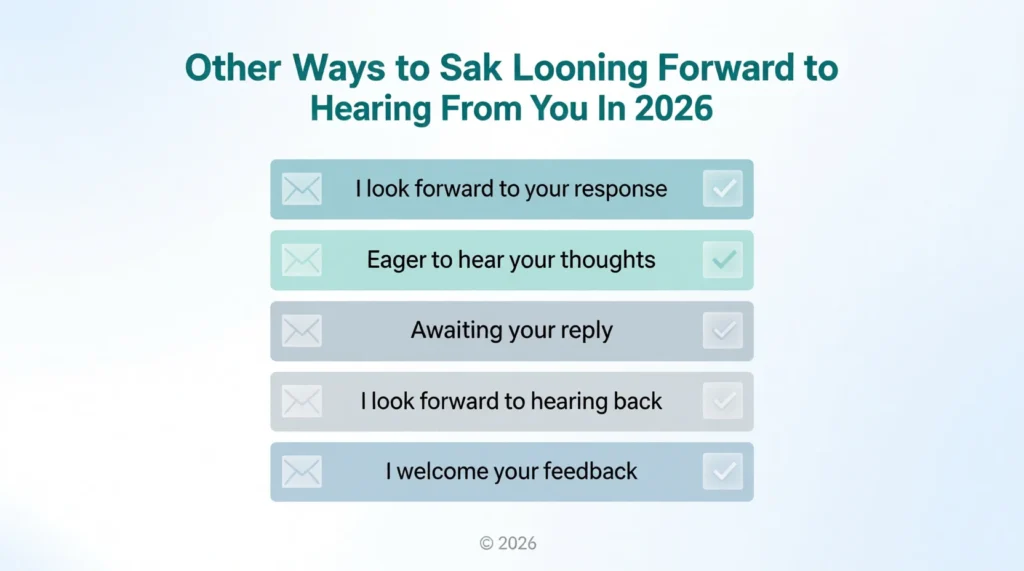
If you want polished, natural other ways to say looking forward to hearing from you, try these top alternatives: I look forward to your response, eager to hear your thoughts, awaiting your reply, I look forward to hearing back, I welcome your feedback.
The phrase looking forward to hearing from you is widely used in emails and messages to express anticipation for a response.
While polite and friendly, it can sound repetitive or overly casual in professional writing if overused.
Learning other ways to say looking forward to hearing from you helps you improve tone control, sound more confident, and express excitement in English appropriately across contexts.
“Professional English is not about complexity, but precision.”
Quick Categories Overview
Formal alternatives to “looking forward to hearing from you”
- I look forward to your response
- I await your reply
- I look forward to receiving your feedback
Pro Tip: Use these in formal emails, job applications, and academic communication.
Casual alternatives
- Excited to hear from you
- Can’t wait to hear back
- Hope to hear from you soon
Pro Tip: Ideal for friendly emails or informal messaging.
Professional alternatives
- I welcome your response
- I look forward to hearing your thoughts
- Please let me know your feedback
Pro Tip: These phrases balance warmth and professionalism well.
Informal expressions
- Looking forward to hearing back
- Hope to hear from you
- Waiting to hear from you
Pro Tip: Avoid these in formal or high-stakes professional writing.
“Tone transforms a simple sentence into a strong closing.”
Common Mistakes When Using “Looking Forward to Hearing From You”
- Using it in every email
Example: Looking forward to hearing from you. (Repeated in all emails) - Using it in very formal documents
Example: Looking forward to hearing from you regarding the legal matter. - Sounding passive instead of proactive
Example: Looking forward to hearing from you someday. - Using it without context
Example: Looking forward to hearing from you. (No reference to what) - Using casual tone in professional emails
Example: Really looking forward to hearing from you!
What Does “Looking Forward to Hearing From You” Mean?
It means you expect and welcome a reply from the other person.
Grammatically, it uses a gerund phrase following “look forward to.”
Example sentence: I am looking forward to hearing from you soon.
When to Use “Looking Forward to Hearing From You”
- Email closings
- Follow-up messages
- Professional correspondence
- Polite reminders
Spoken vs Written: Mostly written
Formal vs Informal: Semi-formal
Is It Professional or Polite to Say “Looking Forward to Hearing From You”?
Polite: Yes
Professional: Sometimes
Business-style example: I look forward to hearing from you regarding the next steps.
Pros and Cons of Using “Looking Forward to Hearing From You”
Pros
- Polite and friendly
- Widely understood
- Suitable for many contexts
- Easy to use
Cons
- Overused in emails
- Can sound generic
- Not always formal enough
- Lacks specificity
“Specific language shows confidence and clarity.”
Other Ways to Say “Looking Forward to Hearing From You” (With Examples)
These alternatives help you sound fluent, confident, and natural in professional and everyday communication.
Use them carefully to express excitement in English without sounding repetitive.
1. Phrase: I look forward to your response
Meaning: I expect your reply.
Explanation: A formal, professional alternative.
Example Sentence: I look forward to your response regarding the proposal.
Best Use: Business emails
Worst Use: Casual texts
Tone: Formal polite
Context Variability: professional written
2. Phrase: I await your reply
Meaning: I am waiting for your response.
Explanation: Very formal tone.
Example Sentence: I await your reply at your convenience.
Best Use: Formal letters
Worst Use: Friendly emails
Tone: Formal neutral
Context Variability: professional written
3. Phrase: I look forward to hearing your thoughts
Meaning: You want their opinion.
Explanation: Engages the recipient.
Example Sentence: I look forward to hearing your thoughts on this matter.
Best Use: Professional discussion
Worst Use: Urgent notices
Tone: Polite engaging
Context Variability: professional
4. Phrase: I welcome your feedback
Meaning: You invite comments.
Explanation: Professional and open.
Example Sentence: I welcome your feedback on the draft.
Best Use: Workplace communication
Worst Use: Casual chat
Tone: Professional open
Context Variability: professional
5. Phrase: I look forward to hearing back from you
Meaning: Anticipating a reply.
Explanation: Slightly less formal.
Example Sentence: I look forward to hearing back from you soon.
Best Use: Semi-formal emails
Worst Use: Legal writing
Tone: Neutral friendly
Context Variability: professional
6. Phrase: Awaiting your response
Meaning: Waiting for reply.
Explanation: Concise and formal.
Example Sentence: Awaiting your response at your earliest convenience.
Best Use: Formal emails
Worst Use: Casual messages
Tone: Formal concise
Context Variability: professional
7. Phrase: I’m eager to hear your thoughts
Meaning: Strong interest shown.
Explanation: Expresses enthusiasm.
Example Sentence: I’m eager to hear your thoughts on this idea.
Best Use: Creative work
Worst Use: Complaints
Tone: Positive enthusiastic
Context Variability: spoken professional
8. Phrase: I hope to hear from you soon
Meaning: Polite expectation.
Explanation: Friendly but neutral.
Example Sentence: I hope to hear from you soon.
Best Use: Follow-ups
Worst Use: Strict deadlines
Tone: Polite friendly
Context Variability: written
9. Phrase: Please let me know your thoughts
Meaning: Requesting feedback.
Explanation: Clear and professional.
Example Sentence: Please let me know your thoughts when convenient.
Best Use: Workplace emails
Worst Use: Informal chat
Tone: Polite direct
Context Variability: professional
10. Phrase: I look forward to your feedback
Meaning: Expecting evaluation.
Explanation: Common in work settings.
Example Sentence: I look forward to your feedback on the report.
Best Use: Business writing
Worst Use: Casual use
Tone: Professional neutral
Context Variability: professional
11. Phrase: I’m looking forward to your reply
Meaning: Anticipating response.
Explanation: Semi-formal phrasing.
Example Sentence: I’m looking forward to your reply.
Best Use: Emails
Worst Use: Formal documents
Tone: Friendly neutral
Context Variability: written
12. Phrase: I would appreciate your response
Meaning: Polite request.
Explanation: Adds courtesy.
Example Sentence: I would appreciate your response by Friday.
Best Use: Professional requests
Worst Use: Casual texts
Tone: Polite respectful
Context Variability: professional
13. Phrase: I look forward to discussing this further
Meaning: Expecting future conversation.
Explanation: Suggests continuation.
Example Sentence: I look forward to discussing this further.
Best Use: Meetings
Worst Use: Simple updates
Tone: Professional collaborative
Context Variability: professional
14. Phrase: I’m interested to hear your opinion
Meaning: Requesting viewpoint.
Explanation: Shows curiosity.
Example Sentence: I’m interested to hear your opinion on this topic.
Best Use: Discussions
Worst Use: Formal notices
Tone: Curious respectful
Context Variability: spoken
15. Phrase: I look forward to your confirmation
Meaning: Awaiting decision.
Explanation: Formal and precise.
Example Sentence: I look forward to your confirmation.
Best Use: Scheduling
Worst Use: Casual chat
Tone: Formal clear
Context Variability: professional
16. Phrase: I anticipate your reply
Meaning: Expecting response.
Explanation: Formal tone.
Example Sentence: I anticipate your reply shortly.
Best Use: Formal emails
Worst Use: Friendly talk
Tone: Formal
Context Variability: professional
17. Phrase: Looking forward to your update
Meaning: Awaiting new information.
Explanation: Semi-formal.
Example Sentence: Looking forward to your update next week.
Best Use: Work communication
Worst Use: Legal writing
Tone: Neutral
Context Variability: professional
18. Phrase: I hope to receive your feedback
Meaning: Polite expectation.
Explanation: Formal polite.
Example Sentence: I hope to receive your feedback soon.
Best Use: Reports
Worst Use: Casual chat
Tone: Polite formal
Context Variability: professional
19. Phrase: Please keep me informed
Meaning: Asking for updates.
Explanation: Direct and professional.
Example Sentence: Please keep me informed of any changes.
Best Use: Workplace
Worst Use: Social talk
Tone: Direct professional
Context Variability: professional
20. Phrase: I look forward to hearing your response
Meaning: Anticipation of reply.
Explanation: Clear and professional.
Example Sentence: I look forward to hearing your response soon.
Best Use: Email closings
Worst Use: Casual texts
Tone: Polite professional
Context Variability: written
21. Phrase: I’d love to hear your thoughts
Meaning: Friendly interest.
Explanation: Warm tone.
Example Sentence: I’d love to hear your thoughts on this.
Best Use: Informal work
Worst Use: Formal letters
Tone: Warm friendly
Context Variability: spoken
22. Phrase: Let me know what you think
Meaning: Requesting opinion.
Explanation: Casual professional.
Example Sentence: Let me know what you think.
Best Use: Teamwork
Worst Use: Formal writing
Tone: Casual polite
Context Variability: spoken
23. Phrase: I look forward to continuing this conversation
Meaning: Ongoing discussion.
Explanation: Professional networking phrase.
Example Sentence: I look forward to continuing this conversation.
Best Use: Networking
Worst Use: Simple emails
Tone: Professional warm
Context Variability: professional
24. Phrase: I await your feedback
Meaning: Formal expectation.
Explanation: Concise formal phrasing.
Example Sentence: I await your feedback on the proposal.
Best Use: Corporate emails
Worst Use: Casual use
Tone: Formal concise
Context Variability: professional
25. Phrase: I’m keen to hear your response
Meaning: Strong interest.
Explanation: Slightly informal enthusiasm.
Example Sentence: I’m keen to hear your response.
Best Use: Creative teams
Worst Use: Legal writing
Tone: Enthusiastic
Context Variability: spoken
26. Phrase: I look forward to your thoughts on this
Meaning: Expecting opinion.
Explanation: Professional tone.
Example Sentence: I look forward to your thoughts on this matter.
Best Use: Workplace discussion
Worst Use: Casual chat
Tone: Polite professional
Context Variability: professional
27. Phrase: I welcome your reply
Meaning: Invitation to respond.
Explanation: Formal but friendly.
Example Sentence: I welcome your reply at your convenience.
Best Use: Professional emails
Worst Use: Informal texts
Tone: Polite formal
Context Variability: written
28. Phrase: I look forward to your update
Meaning: Expecting progress.
Explanation: Common business phrase.
Example Sentence: I look forward to your update tomorrow.
Best Use: Project management
Worst Use: Social use
Tone: Neutral professional
Context Variability: professional
29. Phrase: I’d appreciate hearing from you
Meaning: Polite request.
Explanation: Softens the ask.
Example Sentence: I’d appreciate hearing from you soon.
Best Use: Follow-ups
Worst Use: Strict deadlines
Tone: Polite friendly
Context Variability: written
30. Phrase: I’m waiting to hear from you
Meaning: Expecting response.
Explanation: Direct but less formal.
Example Sentence: I’m waiting to hear from you regarding the details.
Best Use: Casual work
Worst Use: Formal writing
Tone: Neutral
Context Variability: spoken
Comparison Table: Top Alternatives
| Phrase | Tone | Best Use |
|---|---|---|
| I look forward to your response | Formal | Business emails |
| I await your reply | Very formal | Official letters |
| I welcome your feedback | Professional | Workplace |
| I’m eager to hear your thoughts | Enthusiastic | Creative work |
| Please let me know your thoughts | Polite | Professional requests |
| I hope to hear from you soon | Friendly | Follow-ups |
| I look forward to discussing this further | Collaborative | Meetings |
| I’d love to hear your thoughts | Warm | Informal work |
| Awaiting your response | Formal | Email closings |
| Let me know what you think | Casual | Team chats |
“Strong closings leave a professional impression.”
Mini Quiz
- Which phrase is most formal?
A I’d love to hear your thoughts
B I await your reply
C Let me know what you think - Which phrase suits friendly professional emails?
A I await your feedback
B I’m eager to hear your thoughts
C I anticipate your response - Which phrase should be avoided in legal documents?
A I look forward to your response
B I await your reply
C Can’t wait to hear back
Answers: 1 B, 2 B, 3 C
FAQs
What are the most professional alternatives to looking forward to hearing from you?
Phrases like I look forward to your response or I await your reply work best.
Is looking forward to hearing from you too casual?
It is polite but can be too casual for formal or legal communication.
Can I use these phrases in job applications?
Yes, but choose formal alternatives.
How do I sound less repetitive in emails?
Rotate professional reaction phrases based on context.
Why should English learners learn other ways to say looking forward to hearing from you?
It improves clarity, tone awareness, and professional confidence.
Conclusion
Mastering other ways to say looking forward to hearing from you helps you communicate anticipation clearly and professionally.
Practice different alternatives, stay aware of tone, and choose phrases that match your audience and purpose.
Use one new phrase in your next email to build fluency.
Read More Related Article:
- Other Ways to Say Thank You That Sound More Professional (2026)
- Beyond “I’ll Get Back to You”: 30+ Polished Alternatives In 2026
- Other Ways to Say Looking Forward: Formal, Casual and Professional (2026)

Reuben Cook is a dedicated writer at Wordsmirror.com, known for creating clear, engaging, and well-researched content. He focuses on delivering accurate information in a reader-friendly way, making complex topics easy to understand. Reuben’s work reflects a strong commitment to quality, clarity, and meaningful storytelling.