Quick Answer:
“Looking forward” means feeling interested or pleased about something that will happen in the future. Common alternatives include excited about, eager to, anticipating, happy to, and keen on.
The phrase looking forward is widely used in English to express positive expectation or interest in a future event, action, or interaction. It appears frequently in emails, conversations, and everyday written communication.
Although clear and polite, repeated use can reduce variation in language, especially in professional or academic contexts. Learning alternatives to looking forward improves vocabulary range and tone accuracy.
Different expressions also help learners express excitement in English more precisely depending on formality, audience, and purpose.
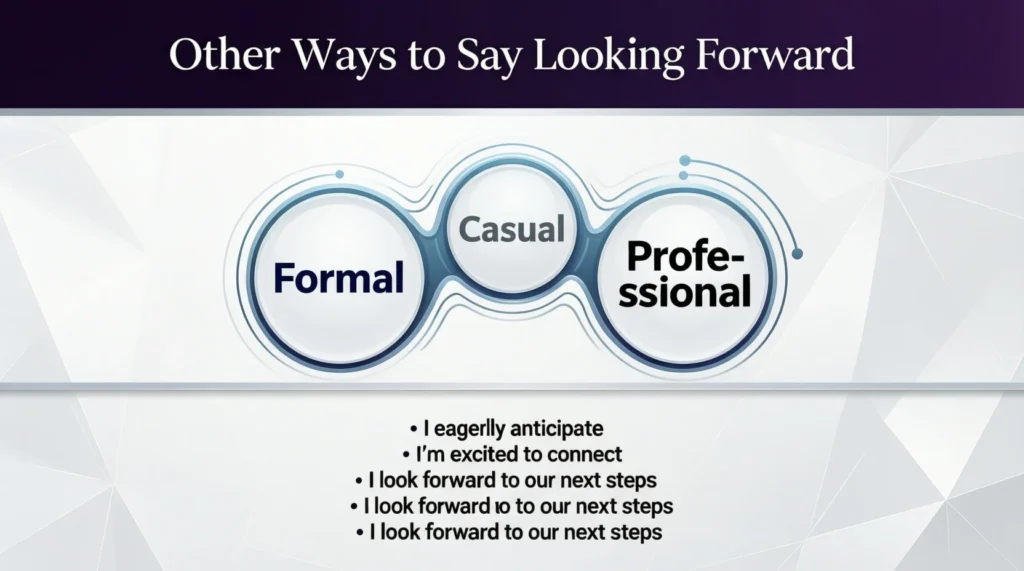
Quick Categories
Formal alternatives to “looking forward”
I anticipate, I await, I look ahead to, I would welcome
Pro Tips:
Use these in official correspondence, reports, or academic writing.
Casual alternatives
Excited about, happy to, keen on, can’t wait
Pro Tips:
Appropriate for informal conversations and personal messages.
Professional alternatives
I am pleased to, I welcome the opportunity, I look forward to collaborating
Pro Tips:
Suitable for workplace emails, meetings, and professional communication.
Informal expressions
Can’t wait, glad to, really excited
Pro Tips:
Avoid these in formal or business contexts.
Common Mistakes When Using “Looking Forward”
- Using it in highly formal documents
Example: I am looking forward to your official directive. - Using the incorrect verb form
Example: I am looking forward to meet you. - Overusing it in professional emails
Example: Ending every email with the same phrase. - Omitting the object
Example: I am looking forward. - Using it in serious or negative situations
Example: I am looking forward to resolving this issue.
What Does “Looking Forward” Mean?
Looking forward means feeling positive, interested, or pleased about a future event or activity.
It is followed by to + verb-ing, not the base verb.
Example sentence:
I am looking forward to hearing from you.
When to Use “Looking Forward”
- Informal emails
- Polite closings
- Casual conversations
- Personal messages
Spoken: Common
Written: Semi-formal
Formal: Limited use
Is It Professional or Polite to Say “Looking Forward”?
Polite: ✔️ Yes
Professional: ❌ No (in most cases)
Business example:
I look forward to your response.
The phrase is polite but often considered too generic for formal professional writing.
Pros and Cons of Using “Looking Forward”
Pros
- Simple and natural
- Friendly tone
- Widely understood
- Easy to use
Cons
- Overused
- Limited range of expression
- Too informal for formal writing
- Not suitable for official documents
Other Ways to Say “Looking Forward” (With Examples)
These alternatives help improve clarity, precision, and tone across different contexts.
Use them according to formality, audience, and purpose to express excitement in English accurately.
1. Phrase: Excited about
Meaning: Feeling pleased about something upcoming.
Explanation: Common in informal communication.
Example Sentence: I am excited about the upcoming event.
Best Use: Casual talk
Worst Use: Formal writing
Tone: Informal, positive
Context Variability: casual
2. Phrase: Eager to
Meaning: Showing strong interest or readiness.
Explanation: Indicates motivation and willingness.
Example Sentence: I am eager to begin the project.
Best Use: Professional settings
Worst Use: Emotional topics
Tone: Neutral, motivated
Context Variability: professional
3. Phrase: Keen on
Meaning: Interested in something.
Explanation: Common in British English.
Example Sentence: She is keen on joining the team.
Best Use: Informal work
Worst Use: Legal documents
Tone: Informal, light
Context Variability: casual
4. Phrase: Anticipating
Meaning: Expecting something to happen.
Explanation: Formal and neutral.
Example Sentence: We are anticipating your reply.
Best Use: Reports
Worst Use: Casual conversation
Tone: Formal, neutral
Context Variability: professional
5. Phrase: Happy to
Meaning: Willing and pleased.
Explanation: Polite and flexible.
Example Sentence: I am happy to assist.
Best Use: Customer service
Worst Use: Strong enthusiasm
Tone: Polite, neutral
Context Variability: professional
6. Phrase: I welcome
Meaning: Showing approval or openness.
Explanation: Formal and respectful.
Example Sentence: I welcome your suggestions.
Best Use: Business emails
Worst Use: Casual talk
Tone: Formal
Context Variability: professional
7. Phrase: Delighted to
Meaning: Very pleased.
Explanation: Polite and positive.
Example Sentence: I am delighted to meet you.
Best Use: Introductions
Worst Use: Neutral updates
Tone: Formal, warm
Context Variability: professional
8. Phrase: Can’t wait
Meaning: Strong excitement.
Explanation: Informal expression.
Example Sentence: I can’t wait to see the results.
Best Use: Friends
Worst Use: Work emails
Tone: Informal
Context Variability: casual
9. Phrase: Enthusiastic about
Meaning: Showing interest and energy.
Explanation: Professional-friendly expression.
Example Sentence: She is enthusiastic about the proposal.
Best Use: Presentations
Worst Use: Complaints
Tone: Professional, positive
Context Variability: professional
10. Phrase: I await
Meaning: Waiting formally.
Explanation: Very formal phrasing.
Example Sentence: I await your instructions.
Best Use: Official letters
Worst Use: Informal messages
Tone: Formal
Context Variability: professional
11. Phrase: Pleased to
Meaning: Satisfied or glad.
Explanation: Neutral and polite.
Example Sentence: I am pleased to confirm the meeting.
Best Use: Emails
Worst Use: Casual chat
Tone: Neutral
Context Variability: professional
12. Phrase: Thrilled about
Meaning: Very excited.
Explanation: Strong emotion, informal.
Example Sentence: She is thrilled about the news.
Best Use: Personal messages
Worst Use: Formal writing
Tone: Emotional
Context Variability: casual
13. Phrase: Optimistic about
Meaning: Expecting a positive outcome.
Explanation: Neutral and thoughtful.
Example Sentence: We are optimistic about the results.
Best Use: Reports
Worst Use: Informal chat
Tone: Neutral
Context Variability: professional
14. Phrase: Interested in
Meaning: Showing curiosity or concern.
Explanation: Neutral interest without emotion.
Example Sentence: I am interested in this position.
Best Use: Applications
Worst Use: Emotional contexts
Tone: Neutral
Context Variability: professional
15. Phrase: Ready for
Meaning: Prepared for something.
Explanation: Focuses on readiness.
Example Sentence: We are ready for the next phase.
Best Use: Planning
Worst Use: Emotional expression
Tone: Neutral
Context Variability: professional
16. Phrase: Hopeful about
Meaning: Expecting something positive.
Explanation: Slightly emotional but polite.
Example Sentence: I am hopeful about the outcome.
Best Use: Updates
Worst Use: Legal documents
Tone: Neutral
Context Variability: professional
17. Phrase: Motivated by
Meaning: Encouraged or driven.
Explanation: Shows internal interest.
Example Sentence: I am motivated by this opportunity.
Best Use: Interviews
Worst Use: Casual chat
Tone: Professional
Context Variability: professional
18. Phrase: Encouraged by
Meaning: Feeling positive due to support.
Explanation: Reflects reassurance.
Example Sentence: We are encouraged by the feedback.
Best Use: Reports
Worst Use: Informal talk
Tone: Neutral
Context Variability: professional
19. Phrase: Inspired by
Meaning: Influenced positively.
Explanation: Indicates creativity or motivation.
Example Sentence: She is inspired by the project.
Best Use: Creative work
Worst Use: Formal notices
Tone: Neutral
Context Variability: professional
20. Phrase: Appreciative of
Meaning: Thankful or respectful.
Explanation: Polite acknowledgment.
Example Sentence: I am appreciative of your support.
Best Use: Professional emails
Worst Use: Casual chat
Tone: Polite
Context Variability: professional
21. Phrase: Open to
Meaning: Willing to consider.
Explanation: Neutral and flexible.
Example Sentence: I am open to suggestions.
Best Use: Discussions
Worst Use: Emotional contexts
Tone: Neutral
Context Variability: professional
22. Phrase: Glad to
Meaning: Pleased or satisfied.
Explanation: Informal and polite.
Example Sentence: I am glad to help.
Best Use: Casual work
Worst Use: Formal writing
Tone: Informal
Context Variability: casual
23. Phrase: Thankful for
Meaning: Showing gratitude.
Explanation: Focuses on appreciation.
Example Sentence: I am thankful for the opportunity.
Best Use: Personal messages
Worst Use: Legal writing
Tone: Neutral
Context Variability: casual
24. Phrase: Pleased with
Meaning: Satisfied about something.
Explanation: Reflects approval.
Example Sentence: We are pleased with the results.
Best Use: Reports
Worst Use: Informal talk
Tone: Neutral
Context Variability: professional
25. Phrase: Expecting
Meaning: Believing something will happen.
Explanation: Neutral expectation.
Example Sentence: We are expecting confirmation.
Best Use: Planning
Worst Use: Emotional contexts
Tone: Neutral
Context Variability: professional
26. Phrase: Keen to
Meaning: Interested in doing something.
Explanation: British English usage.
Example Sentence: He is keen to participate.
Best Use: Informal work
Worst Use: Formal documents
Tone: Informal
Context Variability: casual
27. Phrase: Willing to
Meaning: Ready to do something.
Explanation: Shows cooperation.
Example Sentence: I am willing to assist.
Best Use: Professional offers
Worst Use: Emotional expression
Tone: Neutral
Context Variability: professional
28. Phrase: Delighted by
Meaning: Very pleased with something.
Explanation: Slightly emotional but polite.
Example Sentence: She was delighted by the news.
Best Use: Personal communication
Worst Use: Formal reports
Tone: Neutral
Context Variability: casual
29. Phrase: Excited for
Meaning: Looking forward to an event.
Explanation: Informal variation.
Example Sentence: I am excited for the trip.
Best Use: Casual conversation
Worst Use: Professional writing
Tone: Informal
Context Variability: casual
30. Phrase: Pleased at
Meaning: Satisfied with an outcome.
Explanation: Formal and precise.
Example Sentence: We are pleased at the progress.
Best Use: Reports
Worst Use: Casual chat
Tone: Formal
Context Variability: professional
Mini Quiz: Self-Check
- Which phrase is most appropriate for a formal letter?
A. Can’t wait
B. I await
C. Excited for - Which phrase is informal?
A. Anticipating
B. Keen on
C. I welcome - Which sentence is correct?
A. Looking forward to meet you
B. Looking forward meeting you
C. Looking forward to meeting you
Comparison Table: Top Alternatives
| Phrase | Tone | Best Use |
|---|---|---|
| Excited about | Informal | Conversation |
| Eager to | Neutral | Interviews |
| Anticipating | Formal | Reports |
| Happy to | Polite | Emails |
| Delighted to | Formal | Introductions |
| I welcome | Formal | Business writing |
| Enthusiastic about | Professional | Presentations |
| Keen on | Informal | Informal work |
| I await | Very formal | Official letters |
| Can’t wait | Informal | Friends |
FAQs
Is “looking forward” informal?
It is polite but slightly informal.
Can it be used in professional emails?
Yes, but repeated use should be avoided.
What is the most formal alternative?
“I await” or “I anticipate.”
Is “eager to” professional?
Yes, when used appropriately.
How can I express excitement in English professionally?
Use neutral phrases such as “enthusiastic about” or “pleased to.”
Conclusion
Learning other ways to say looking forward improves accuracy, vocabulary range, and tone awareness. Different expressions allow clearer communication across professional and informal contexts.
Consistent practice and attention to context support more precise and effective English usage.

Reuben Cook is a dedicated writer at Wordsmirror.com, known for creating clear, engaging, and well-researched content. He focuses on delivering accurate information in a reader-friendly way, making complex topics easy to understand. Reuben’s work reflects a strong commitment to quality, clarity, and meaningful storytelling.