Quick Answer:
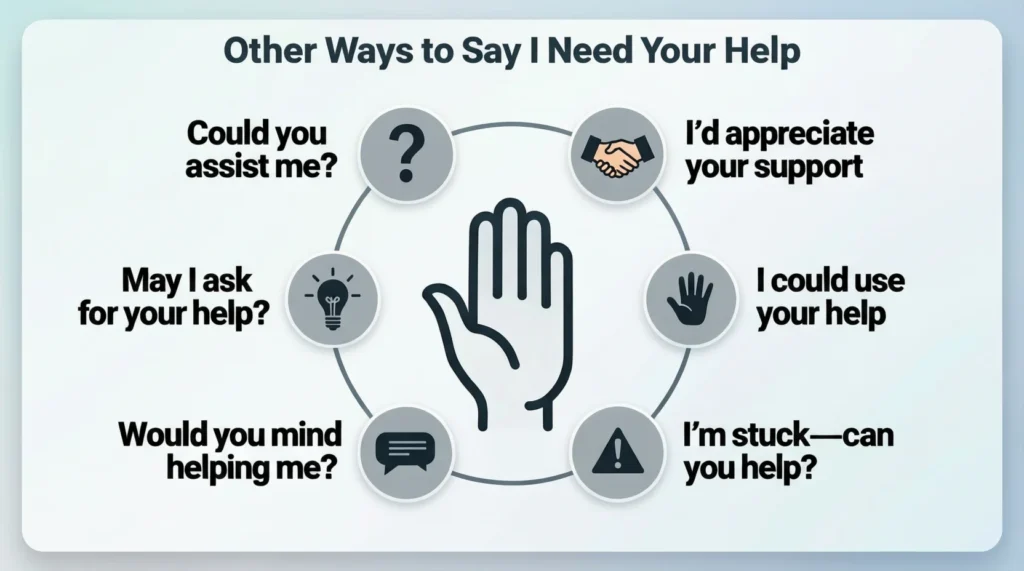
If you’re looking for other ways to say I need your help, try these effective alternatives: Could you assist me?, I’d appreciate your support, May I ask for your help?, I could use your help, Would you mind helping me?
The phrase I need your help is one of the most commonly used expressions in English for asking assistance, support, or guidance.
People use it in daily conversations, workplaces, academic settings, and professional emails, but repeating it too often can sound blunt or overly direct.
Learning alternatives to I need your help helps English learners sound more polite, confident, and natural, while allowing them to express excitement in English and professionalism appropriately.
“The way you ask for help can define how polite and professional you sound.”
Quick Categories Overview
Formal alternatives to “I need your help”
- I would appreciate your assistance
- I kindly request your support
- I would be grateful for your help
Pro Tip: Use these in formal emails, official requests, or academic writing.
Casual alternatives
- Can you help me out?
- I could use your help
- Help me with this
Pro Tip: Best for friends, family, and relaxed conversations.
Professional alternatives
- Could you assist me with this?
- May I ask for your support?
- I’d appreciate your input
Pro Tip: Ideal for workplace communication and collaboration.
Informal expressions
- Can you give me a hand?
- Mind helping me?
- I need a hand here
Pro Tip: Avoid these in formal or written business communication.
“Politeness turns a request into cooperation.”
Common Mistakes When Using “I Need Your Help”
- Sounding too demanding
Example: I need your help right now. - Using it without politeness markers
Example: I need your help with this task. - Using it in very formal documents
Example: I need your help regarding this matter. - Overusing the phrase repeatedly
Example: I need your help mentioned in every sentence. - Using informal versions in professional settings
Example: I need a hand with the report.
What Does “I Need Your Help” Mean?
It means asking someone for assistance, guidance, or support to complete a task or solve a problem.
Grammatically, it is a direct request using the verb need, which can sound strong without softening phrases.
Example sentence: I need your help finishing this assignment.
When to Use “I Need Your Help”
Common contexts include:
- Asking for assistance
- Seeking guidance
- Requesting collaboration
- Solving problems
Spoken vs Written: More common in speech
Formal vs Informal: Mostly informal unless softened
Is It Professional or Polite to Say “I Need Your Help”?
Polite: Yes, with context
Professional: No, in most cases
Business-style example: I need your help reviewing this proposal.
Pros and Cons of Using “I Need Your Help”
Pros
- Clear and direct
- Easy to understand
- Common usage
- Friendly in casual settings
Cons
- Sounds demanding in professional contexts
- Overused
- Limited politeness
- Not ideal for formal writing
“Professional English prefers polite requests over direct needs.”
Other Ways to Say “I Need Your Help” With Examples
These alternatives will help you sound more fluent, confident, and natural in different situations.
Use them according to tone, context, and audience to express excitement in English, professionalism, or politeness.
1. Phrase: Could you assist me?
Meaning: Asking for help politely.
Explanation: Formal and professional.
Example Sentence: Could you assist me with this report?
Best Use: Workplace
Worst Use: Casual chat
Tone: Polite formal
Context Variability: professional written
2. Phrase: I would appreciate your assistance
Meaning: Asking for help respectfully.
Explanation: Shows gratitude in advance.
Example Sentence: I would appreciate your assistance with this matter.
Best Use: Formal emails
Worst Use: Informal talk
Tone: Respectful formal
Context Variability: professional
3. Phrase: May I ask for your help?
Meaning: Polite request for help.
Explanation: Softens the request.
Example Sentence: May I ask for your help with this task?
Best Use: Polite requests
Worst Use: Emergencies
Tone: Polite gentle
Context Variability: spoken professional
4. Phrase: I’d appreciate your support
Meaning: Asking for assistance diplomatically.
Explanation: Professional tone.
Example Sentence: I’d appreciate your support on this project.
Best Use: Work collaboration
Worst Use: Casual favors
Tone: Professional polite
Context Variability: professional
5. Phrase: Could you help me with this?
Meaning: Simple polite request.
Explanation: Neutral and clear.
Example Sentence: Could you help me with this issue?
Best Use: General use
Worst Use: Formal documents
Tone: Neutral polite
Context Variability: spoken
6. Phrase: I could use your help
Meaning: Needing assistance casually.
Explanation: Friendly and informal.
Example Sentence: I could use your help setting this up.
Best Use: Casual talk
Worst Use: Formal emails
Tone: Friendly
Context Variability: casual spoken
7. Phrase: Would you mind helping me?
Meaning: Polite indirect request.
Explanation: Soft and respectful.
Example Sentence: Would you mind helping me with this file?
Best Use: Polite conversations
Worst Use: Urgent tasks
Tone: Gentle polite
Context Variability: spoken
8. Phrase: I need some assistance
Meaning: Asking for help formally.
Explanation: Less direct than “help.”
Example Sentence: I need some assistance with the documentation.
Best Use: Workplace
Worst Use: Casual talk
Tone: Professional
Context Variability: professional
9. Phrase: Can you give me a hand?
Meaning: Informal request for help.
Explanation: Friendly expression.
Example Sentence: Can you give me a hand with this box?
Best Use: Casual speech
Worst Use: Business emails
Tone: Informal friendly
Context Variability: casual
10. Phrase: I’m looking for your help
Meaning: Requesting assistance politely.
Explanation: Slightly indirect.
Example Sentence: I’m looking for your help with this task.
Best Use: Semi formal
Worst Use: Urgent matters
Tone: Neutral
Context Variability: spoken
11. Phrase: Could you support me with this?
Meaning: Asking for help professionally.
Explanation: Suitable for teamwork.
Example Sentence: Could you support me with this presentation?
Best Use: Work context
Worst Use: Casual favors
Tone: Professional
Context Variability: professional
12. Phrase: I’d like to ask for your help
Meaning: Polite formal request.
Explanation: Structured and respectful.
Example Sentence: I’d like to ask for your help on this issue.
Best Use: Formal requests
Worst Use: Informal chat
Tone: Formal polite
Context Variability: professional
13. Phrase: Can you help me out?
Meaning: Casual help request.
Explanation: Friendly tone.
Example Sentence: Can you help me out with this?
Best Use: Friends
Worst Use: Formal writing
Tone: Casual
Context Variability: casual spoken
14. Phrase: I’d value your help
Meaning: Appreciating assistance.
Explanation: Positive and polite.
Example Sentence: I’d value your help on this matter.
Best Use: Professional
Worst Use: Casual chat
Tone: Respectful
Context Variability: professional
15. Phrase: I’m seeking your assistance
Meaning: Formal help request.
Explanation: Very professional.
Example Sentence: I’m seeking your assistance regarding this issue.
Best Use: Official communication
Worst Use: Informal talk
Tone: Formal
Context Variability: professional
16. Phrase: Could you lend a hand?
Meaning: Informal request.
Explanation: Friendly and casual.
Example Sentence: Could you lend a hand here?
Best Use: Casual help
Worst Use: Formal emails
Tone: Friendly
Context Variability: casual
17. Phrase: I need some support
Meaning: Asking for help gently.
Explanation: Softer than “help.”
Example Sentence: I need some support with this project.
Best Use: Professional talk
Worst Use: Casual favors
Tone: Neutral
Context Variability: professional
18. Phrase: Would you be able to help me?
Meaning: Polite inquiry.
Explanation: Non demanding tone.
Example Sentence: Would you be able to help me later today?
Best Use: Polite requests
Worst Use: Emergencies
Tone: Polite
Context Variability: spoken
19. Phrase: I’m asking for your help
Meaning: Direct but respectful.
Explanation: Clear intent.
Example Sentence: I’m asking for your help with this issue.
Best Use: Direct communication
Worst Use: Formal writing
Tone: Neutral
Context Variability: spoken
20. Phrase: I’d appreciate your guidance
Meaning: Asking for advice or help.
Explanation: Professional tone.
Example Sentence: I’d appreciate your guidance on this matter.
Best Use: Mentorship
Worst Use: Casual chat
Tone: Professional
Context Variability: professional
21. Phrase: Can I ask you a favor?
Meaning: Informal request.
Explanation: Friendly and polite.
Example Sentence: Can I ask you a favor?
Best Use: Casual favors
Worst Use: Formal emails
Tone: Friendly
Context Variability: casual
22. Phrase: I need your assistance
Meaning: Formal help request.
Explanation: Professional alternative.
Example Sentence: I need your assistance with the review.
Best Use: Work emails
Worst Use: Casual talk
Tone: Formal
Context Variability: professional
23. Phrase: I’m hoping you can help
Meaning: Polite and indirect.
Explanation: Soft request.
Example Sentence: I’m hoping you can help me with this.
Best Use: Polite conversation
Worst Use: Urgent needs
Tone: Gentle
Context Variability: spoken
24. Phrase: Would you kindly help me?
Meaning: Very polite request.
Explanation: Formal courtesy.
Example Sentence: Would you kindly help me complete this form?
Best Use: Formal requests
Worst Use: Casual talk
Tone: Polite formal
Context Variability: professional
25. Phrase: I could really use your help
Meaning: Emphasized need.
Explanation: Emotional but polite.
Example Sentence: I could really use your help right now.
Best Use: Personal talk
Worst Use: Formal writing
Tone: Sincere
Context Variability: spoken
26. Phrase: I’m requesting your help
Meaning: Direct formal request.
Explanation: Professional phrasing.
Example Sentence: I’m requesting your help with this task.
Best Use: Work communication
Worst Use: Casual chat
Tone: Formal
Context Variability: professional
27. Phrase: Could you step in and help?
Meaning: Asking for intervention.
Explanation: Semi formal.
Example Sentence: Could you step in and help resolve this?
Best Use: Team issues
Worst Use: Casual favors
Tone: Professional
Context Variability: professional
28. Phrase: I’d be grateful for your help
Meaning: Polite appreciation.
Explanation: Gratitude focused.
Example Sentence: I’d be grateful for your help with this.
Best Use: Polite requests
Worst Use: Casual slang
Tone: Respectful
Context Variability: professional
29. Phrase: I’m reaching out for help
Meaning: Requesting assistance.
Explanation: Common in emails.
Example Sentence: I’m reaching out for help regarding this issue.
Best Use: Emails
Worst Use: Casual chat
Tone: Professional
Context Variability: written
30. Phrase: Can you assist me with this?
Meaning: Professional help request.
Explanation: Clear and polite.
Example Sentence: Can you assist me with this assignment?
Best Use: Academic or work
Worst Use: Informal chat
Tone: Professional
Context Variability: professional
Comparison Table: Top Alternatives
| Phrase | Tone | Best Use |
|---|---|---|
| I would appreciate your assistance | Formal | Business emails |
| Could you assist me? | Professional | Workplace |
| Can you help me out? | Casual | Friends |
| I’d appreciate your guidance | Professional | Mentorship |
| Would you mind helping me? | Polite | Requests |
| I could use your help | Casual | Informal talk |
| I need your assistance | Formal | Work |
| Can you give me a hand? | Informal | Spoken English |
| I’d be grateful for your help | Polite | Requests |
| I’m seeking your assistance | Formal | Official use |
“Choosing the right request builds respect and cooperation.”
Mini Quiz
- Which phrase is best for a formal email?
A Can you help me out?
B I would appreciate your assistance
C Can you give me a hand? - Which phrase is most casual?
A I’m seeking your assistance
B Could you assist me?
C Can you help me out? - Which phrase fits professional teamwork?
A I need a hand
B I’d appreciate your support
C Help me with this
Answers: 1 B, 2 C, 3 B
FAQs
What are the best professional alternatives to I need your help?
Use phrases like I would appreciate your assistance or Could you assist me?
Is I need your help polite enough for work?
It is polite but often too direct without softening phrases.
How can I ask for help more politely in English?
Add modal verbs like could, would, or phrases showing appreciation.
Are there informal expressions in English for asking help?
Yes, phrases like Can you help me out? or Give me a hand are common.
Why should English learners learn other ways to say I need your help?
It improves tone control, confidence, and professional communication.
Conclusion
Learning other ways to say I need your help allows you to communicate requests with clarity, politeness, and confidence.
Practice using different phrases daily, stay aware of tone, and match your language to the situation for fluent English.
Share your favorite alternative and start practicing today.
Read More Related Article:
- Beyond “I’ll Get Back to You”: 30+ Polished Alternatives In 2026
- How to Say “Please Be Reminded” More Naturally In 2026
- How to Sound Smart in Any Argument With Funny Big Words (2026)

Peter Murphy is an experienced writer at wordsmirror.com, where he creates informative and engaging content on language, meanings, and modern usage. He is known for his clear writing style, strong research skills, and ability to explain topics in a simple, reader-friendly way.