Quick Answer:
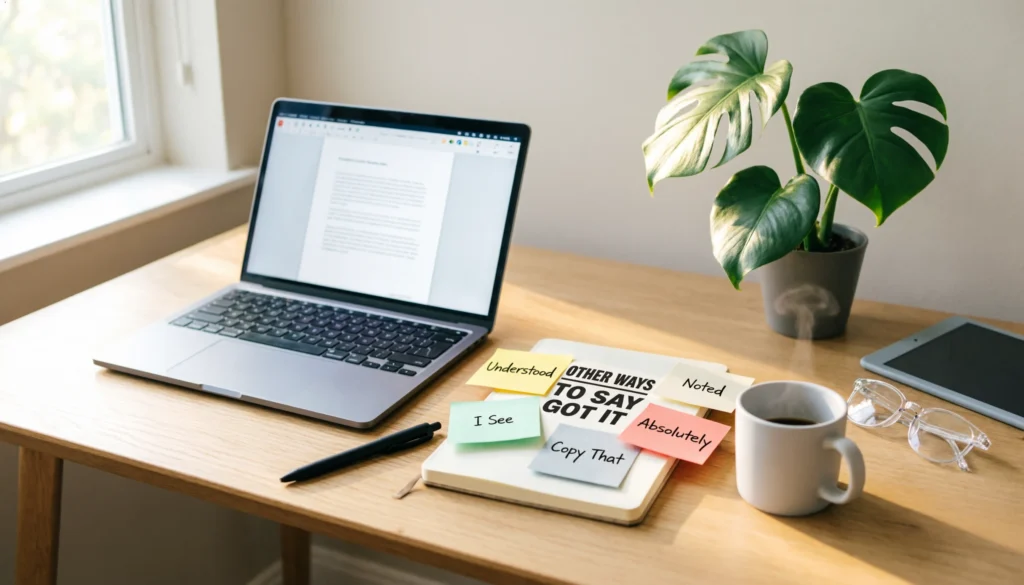
If you’re looking for other ways to say got it, here are five strong alternatives: I understand, Understood, I see, Noted, That makes sense.
These alternatives to other ways to say got it help you sound more fluent, professional, and confident in different situations.
“Got it” is one of the most common reaction phrases in English. People use it to show they understand something, agree with instructions, or acknowledge information.
However, relying on just one phrase can make your English sound repetitive or too casual. Learning other ways to say got it helps you adjust your tone for formal, casual, or professional communication.
If you want to express excitement in English, respond professionally in meetings, or use better informal expressions in English, expanding your vocabulary makes a big difference.
“The right reaction phrase instantly changes how professional you sound.”
Quick Categories
Formal Alternatives to “Got It”
- I understand
- Understood
- I acknowledge
- Duly noted
Pro Tip: Use full sentences in formal emails instead of short responses.
Casual Alternatives
- I see
- Okay
- Makes sense
- Alright
Pro Tip: Keep your tone natural and relaxed in conversations with friends.
Professional Alternatives
- Noted
- I will proceed accordingly
- Message received
- That is clear
Pro Tip: In meetings, clarity matters more than speed. Speak clearly and confidently.
Informal Expressions
- Gotcha
- Cool
- Right
- Sounds good
Pro Tip: Avoid slang like “Gotcha” in formal writing.
“Professional communication depends on tone, not just vocabulary.”
Common Mistakes When Using “Got It”
- Using it in formal emails
Example: “Got it.” (Too short for a client email.) - Sounding dismissive
Example: “Yeah, got it.” (May sound impatient.) - Using it without confirming details
Example: “Got it.” (But you actually misunderstood.) - Overusing it in meetings
Example: Repeating “Got it” after every sentence. - Using it in serious or sensitive discussions
Example: “Got it.” (May sound emotionally cold.)
What Does “Got It” Mean?
“Got it” means I understand, I received the information, or I accept what you said.
Grammar note:
It uses the past form “got,” but the meaning is present understanding.
Example sentence:
“I got it. You want the report by Friday.”
When to Use “Got It”
Common contexts:
- Following instructions
- Confirming information
- Responding in conversation
- Acknowledging messages
Spoken vs Written:
- Very common in spoken English
- Less appropriate in formal writing
Formal vs Informal:
- Informal ✔
- Formal ❌
Is It Professional or Polite to Say “Got It”?
Polite? ✔️ Yes
Professional? ❌ No (in most cases)
Business example:
Instead of: “Got it.”
Say: “Understood. I will complete the task by 3 PM.”
It is polite but often too casual for workplace communication. Use more professional reaction phrases in emails and reports.
Pros and Cons of Using “Got It”
Pros
- Simple and natural
- Friendly tone
- Common usage
- Easy to understand
Cons
- Too informal for work
- Overused
- Limited emotional range
- Not suitable for formal writing
“Fluent speakers choose reaction phrases based on audience and context.”
Other Ways to Say “Got It” (With Examples)
These alternatives will help you sound more fluent, confident, and natural in different situations.
Use them according to tone, context, and audience to express excitement in English, agreement, or acknowledgment.
1. Phrase: I understand
Meaning: I clearly understand what you said.
Explanation: Neutral and widely acceptable.
Example Sentence: I understand your concerns.
Best Use: Meetings, emails
Worst Use: Casual texting
Tone: Clear, respectful
Context Variability: professional, spoken
2. Phrase: Understood
Meaning: I fully understand.
Explanation: Slightly more formal.
Example Sentence: Understood. I’ll handle it.
Best Use: Workplace
Worst Use: Friendly chat
Tone: Direct, professional
Context Variability: professional
3. Phrase: I see
Meaning: I now understand.
Explanation: Common in conversation.
Example Sentence: Oh, I see what you mean.
Best Use: Conversation
Worst Use: Formal report
Tone: Natural, thoughtful
Context Variability: spoken
4. Phrase: Noted
Meaning: I have taken note.
Explanation: Short and business-like.
Example Sentence: Noted. I’ll update the file.
Best Use: Emails
Worst Use: Emotional talk
Tone: Brief, professional
Context Variability: professional
5. Phrase: That makes sense
Meaning: It is logical.
Explanation: Shows agreement and understanding.
Example Sentence: That makes sense now.
Best Use: Discussion
Worst Use: Strict instructions
Tone: Agreeable, warm
Context Variability: casual, spoken
6. Phrase: Message received
Meaning: I got your message.
Explanation: Confirms receipt.
Example Sentence: Message received. Thank you.
Best Use: Digital communication
Worst Use: Face-to-face
Tone: Professional, clear
Context Variability: professional
7. Phrase: I acknowledge
Meaning: I confirm I received this.
Explanation: Very formal.
Example Sentence: I acknowledge receipt of your email.
Best Use: Official emails
Worst Use: Casual chat
Tone: Formal, official
Context Variability: professional
8. Phrase: I’ll take care of it
Meaning: I understand and will act.
Explanation: Adds responsibility.
Example Sentence: I’ll take care of it right away.
Best Use: Workplace
Worst Use: If unsure
Tone: Confident, proactive
Context Variability: professional
9. Phrase: Sounds good
Meaning: I agree.
Explanation: Casual agreement.
Example Sentence: Sounds good to me.
Best Use: Friends
Worst Use: Client email
Tone: Relaxed, friendly
Context Variability: casual
10. Phrase: All right
Meaning: Okay, understood.
Explanation: Neutral response.
Example Sentence: All right, I’ll do that.
Best Use: General use
Worst Use: Formal report
Tone: Neutral
Context Variability: spoken
11. Phrase: Gotcha
Meaning: I understand.
Explanation: Informal expression.
Example Sentence: Gotcha, no problem.
Best Use: Friends
Worst Use: Business
Tone: Casual, relaxed
Context Variability: informal
12. Phrase: Crystal clear
Meaning: Completely clear.
Explanation: Emphasizes understanding.
Example Sentence: Crystal clear, thanks.
Best Use: Meetings
Worst Use: Formal letter
Tone: Positive, confident
Context Variability: spoken
13. Phrase: Copy that
Meaning: I understand (military origin).
Explanation: Used playfully or professionally.
Example Sentence: Copy that, I’m on it.
Best Use: Team talk
Worst Use: Legal writing
Tone: Direct
Context Variability: spoken
14. Phrase: Right
Meaning: I understand.
Explanation: Very brief acknowledgment.
Example Sentence: Right, that helps.
Best Use: Conversation
Worst Use: Formal email
Tone: Minimal
Context Variability: spoken
15. Phrase: Okay
Meaning: I understand or agree.
Explanation: Universal response.
Example Sentence: Okay, I’ll send it.
Best Use: Daily talk
Worst Use: Official writing
Tone: Neutral
Context Variability: casual
16. Phrase: Makes sense
Meaning: It is logical.
Explanation: Casual version of “That makes sense.”
Example Sentence: Makes sense now.
Best Use: Discussion
Worst Use: Formal report
Tone: Friendly
Context Variability: casual
17. Phrase: I follow
Meaning: I understand your explanation.
Explanation: Good in discussions.
Example Sentence: I follow your reasoning.
Best Use: Academic talk
Worst Use: Texting
Tone: Thoughtful
Context Variability: professional
18. Phrase: I’m with you
Meaning: I understand and agree.
Explanation: Shows support.
Example Sentence: I’m with you on this idea.
Best Use: Teamwork
Worst Use: Formal writing
Tone: Supportive
Context Variability: spoken
19. Phrase: Fair enough
Meaning: I accept your point.
Explanation: Indicates acceptance.
Example Sentence: Fair enough, let’s proceed.
Best Use: Discussion
Worst Use: Strict instructions
Tone: Balanced
Context Variability: casual
20. Phrase: That’s clear
Meaning: It is understandable.
Explanation: Slightly formal.
Example Sentence: That’s clear. Thank you.
Best Use: Workplace
Worst Use: Emotional talk
Tone: Professional
Context Variability: professional
21. Phrase: Consider it done
Meaning: I understand and will complete it.
Explanation: Confident commitment.
Example Sentence: Consider it done by noon.
Best Use: Workplace
Worst Use: If uncertain
Tone: Confident
Context Variability: professional
22. Phrase: I’ll handle it
Meaning: I understand and will manage it.
Explanation: Shows responsibility.
Example Sentence: I’ll handle it immediately.
Best Use: Office
Worst Use: If not assigned
Tone: Proactive
Context Variability: professional
23. Phrase: I get the idea
Meaning: I understand generally.
Explanation: Slightly informal.
Example Sentence: I get the idea now.
Best Use: Conversation
Worst Use: Official meeting
Tone: Casual
Context Variability: spoken
24. Phrase: Clear
Meaning: Understood.
Explanation: Very short and direct.
Example Sentence: Clear. I’ll proceed.
Best Use: Quick response
Worst Use: Formal email
Tone: Direct
Context Variability: spoken
25. Phrase: Absolutely
Meaning: Strong agreement.
Explanation: Shows enthusiasm.
Example Sentence: Absolutely, I understand.
Best Use: Positive talk
Worst Use: Neutral instruction
Tone: Energetic
Context Variability: spoken
26. Phrase: Indeed
Meaning: Yes, I understand.
Explanation: More formal tone.
Example Sentence: Indeed, that is correct.
Best Use: Formal discussion
Worst Use: Casual chat
Tone: Formal
Context Variability: professional
27. Phrase: Roger that
Meaning: I understand.
Explanation: Military origin, informal use.
Example Sentence: Roger that, boss.
Best Use: Friendly team
Worst Use: Clients
Tone: Playful
Context Variability: informal
28. Phrase: That’s understood
Meaning: It is understood.
Explanation: Formal variation.
Example Sentence: That’s understood.
Best Use: Business
Worst Use: Casual talk
Tone: Formal
Context Variability: professional
29. Phrase: I appreciate the clarification
Meaning: I understand better now.
Explanation: Polite and professional.
Example Sentence: I appreciate the clarification.
Best Use: Email reply
Worst Use: Quick chat
Tone: Polite
Context Variability: professional
30. Phrase: Thanks for explaining
Meaning: I understand and thank you.
Explanation: Warm acknowledgment.
Example Sentence: Thanks for explaining that.
Best Use: Conversation
Worst Use: Formal contract
Tone: Friendly
Context Variability: casual
“Strong communication is not about big vocabulary. It’s about the right phrase at the right time.”
Mini Quiz: Self Check
- Which phrase is best for a formal email?
A) Gotcha
B) Understood
C) Cool - Which phrase sounds too informal for clients?
A) Noted
B) Roger that
C) I acknowledge - You want to express excitement in English during a meeting. Best choice?
A) Absolutely
B) Got it
C) Okay
Answers: 1-B, 2-B, 3-A
Comparison Table: Top Alternatives
| Phrase | Tone | Best Use |
|---|---|---|
| I understand | Neutral | Meetings |
| Understood | Professional | Workplace |
| Noted | Brief | Emails |
| I see | Natural | Conversation |
| That makes sense | Warm | Discussion |
| I acknowledge | Formal | Official emails |
| Sounds good | Friendly | Friends |
| Consider it done | Confident | Tasks |
| Crystal clear | Positive | Team talk |
| Message received | Direct | Digital communication |
FAQs
What are the best professional alternatives to “got it”?
Understood, Noted, I acknowledge, and I will proceed accordingly are strong professional reaction phrases.
Is “got it” rude?
No, it is polite but informal.
How can I sound more professional than saying “got it”?
Use clear alternatives to other ways to say got it like “Understood” or “I appreciate the clarification.”
Can I use “got it” in emails?
Yes, but only in informal emails.
What informal expressions in English mean “got it”?
Gotcha, Sounds good, Makes sense, and Right are common informal expressions in English.
Conclusion
Learning other ways to say got it improves your fluency, tone control, and confidence. It helps you choose the right phrase for friends, meetings, emails, and professional settings.
Practice using these alternatives to other ways to say got it daily. The more you adjust your tone, the more natural and polished your English will sound.
Read More Related Articles:
- Other Ways to Say Ways to Speak Up When You Feel Used (2026)
- Other Ways to Say “Do Your Best”: Upgrade Your Encouragement In 2026
- Other Ways to Say Thank You With 30+ Examples In 2026

Peter Murphy is an experienced writer at wordsmirror.com, where he creates informative and engaging content on language, meanings, and modern usage. He is known for his clear writing style, strong research skills, and ability to explain topics in a simple, reader-friendly way.